

Matteo Peraldo
Partner & Managing Director - Dallas


This article was originally published in Aviation Week on February 27, 2026. Download a copy of this article here.
The case for separating aerospace and defense businesses from broader industrial production has never been stronger, and the drivers are not just activist investors who have championed such splits for a decade or more.
The paths of technology, material science, customer demand signals and regulation are diverging. Mixed portfolios that once promised resilience have become a drag on performance rather than a source of strength. Complexity is out. It’s all about focus now.
Wall Street has delivered its judgment. Since General Electric’s breakup, GE Aerospace’s shares have almost doubled, and GE Vernova has more than tripled in value. Howmet, which evolved from its Alcoa heritage into a focused engineered components and materials player, has delivered a remarkable 1,800%+ return since its 2020 separation.
Private equity has accelerated the trend, with Barnes split into a focused aerospace business and a separate industrial solutions unit, each with its own equity story and likely different valuation multiples.
Aerospace franchises are often undervalued inside mixed portfolios. Complexity and overhead dilute performance and slow decision-making. There is not a quick-fix playbook. Some combinations still work; others require greater scrutiny.
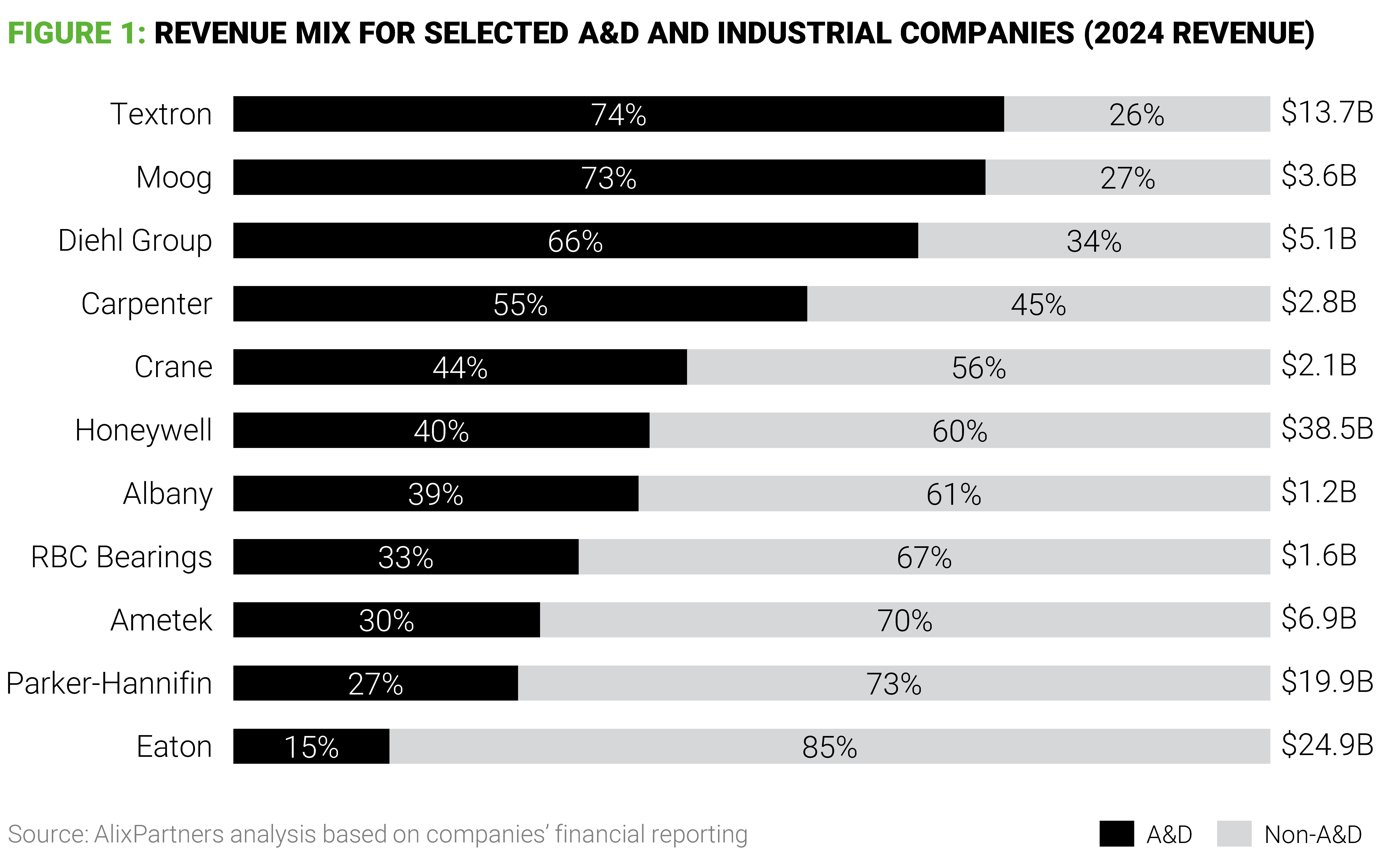
The pressure is now squarely on the remaining diversified groups, such as Textron, that still combine aerospace and defense and industrial markets. Companies straddling those markets should demonstrate that their existing structure creates tangible value that cannot be surpassed by separation through carve-outs.
That is a high bar. In practice, promised synergies from shared corporate functions, common research and development or cross-selling rarely offset the cost and distraction of managing fundamentally different businesses.
Industrial “baggage” can complicate or block portfolio moves that aerospace units need, scale-building mergers and bolt-on acquisitions. In an industry where scale is increasingly the ticket to compete (AW&ST March 25–April 7, 2024, p. 66), this constraint becomes a strategic liability.
Activists have understood this and brought it before many boards. Their playbook is increasingly consistent: Build a stake, highlight the conglomerate discount, frame aerospace as the underleveraged crown jewel and call for a strategic review that evaluates separation or divestitures.
For underscale aerospace assets trapped in multisegment structures, “try harder” is no longer a credible answer. It is best to part ways. What should management teams do in this environment?
First, management needs a compelling value creation plan that explains how the current portfolio will outperform as is—on growth, margins, cash, and capital deployment—and why this beats the alternative of a breakup. The plan must be concrete and come with specific cost actions, prioritized growth bets, disciplined merger and acquisition and a clear stance on shareholder returns.
Leadership teams should quietly ensure they are separation-ready, even if they are not actively pursuing a breakup. That requires well-developed carve-out scenarios, delineated businesses with clean financials and standalone operating models that can be executed quickly.
The objective is to move fast, create self-standing, properly capitalized aerospace and defense and industrial champions, and limit the operational drag of complex entanglements and long Transition Service Arrangements. Untangling information technology links across different businesses is often the long pole in executing separations.
Focused aerospace and defense players will need to use their sharper equity stories and cleaner balance sheets to pursue consolidation, move up the value chain from components to subsystems, and invest aggressively in technology and aftermarket capabilities. The rapid growth of defense tech startups provides ample fodder for established companies to refresh their intellectual property pipeline through targeted merger and acquisition.
The market is sending the clear message that the diversified model that once protected aerospace businesses now holds most of them back. Breaking up is fast becoming the only credible route to unlock trapped value, restore strategic clarity and compete on equal terms with focused champions. These are the businesses that will shape next-generation aircraft programs.
The strategic logic of separating aerospace from adjacent industrial production is not theoretical—it is already playing out across the industrial landscape.
To pressure-test where trapped A&D value sits inside diversified industrials, we mapped a universe of public companies across two dimensions: valuation multiple and A&D revenue share, with bubble size as a proxy for A&D revenue. The picture is striking.
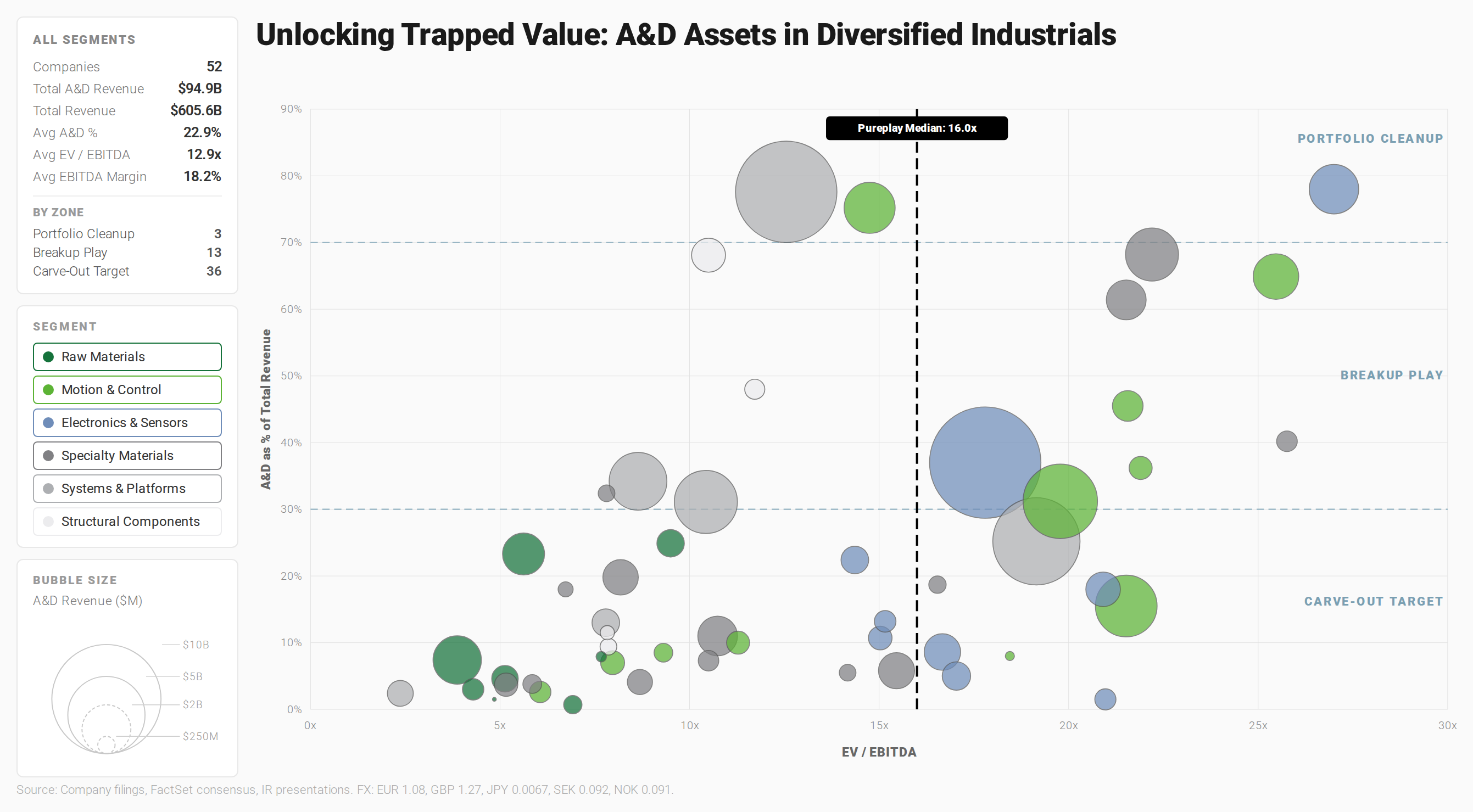
Figure 2: The A&D Value Unlock Map
The carve-out target zone contains a significant number of companies—including Syensqo, SKF, and Eaton prior to the spinoff of its mobility unit. These are the hidden gems: A&D is non-core for a conglomerate, yet often sizable. When the whole company trades at a single-digit EBITDA multiple, the opportunity to create value is self-evident. In several cases, the A&D business alone is potentially worth more than the current enterprise value of the whole group.
The breakup play zone is a different game entirely. Companies such as Crane, Carpenter, and Albany International carry meaningful A&D exposure (often as their core business), yet remain far from pure plays. This is precisely the point at which the separation logic begins to feel compelling.
The portfolio cleanup zone is almost pure play—but not yet. A&D is the dominant business, but legacy industrial assets still cloud the narrative and may penalize the multiple. Textron, Moog, and even Howmet—despite its increasingly focused profile following the Alcoa separation—all illustrate this dynamic.
Portfolio cleanup companies: There is no better time than now to conduct a rigorous portfolio review and sharpen the equity story. The market is no longer rewarding complexity—and if you are trading at a discount to peers, a clearer, more focused narrative could go a long way toward closing that gap. AlixPartners has a strong track record in helping companies carve out businesses in a clear, effective, and accretive way.
Breakup play companies: We can work with you on a compelling value-creation plan designed to beat investor expectations, while quietly building the case for separation—whether as a plan B or the clear path forward.
You want to be ready if an activist knocks at your door. We will make sure you have all the answers. Should you decide to pursue the separation, AlixPartners will bring the experience from having worked on the most high-profile corporate breakups in the industry.
Carve-out target companies: The A&D unit inside your portfolio may be worth significantly more as a standalone. We help assess the opportunity to create shareholder value by taking full advantage of A&D trading multiples—building the investment case, the operational blueprint, and the execution path for a successful separation.
For private equity: A clear window is opening for "buy-and-break" strategies—acquiring diversified industrial groups and unlocking hidden A&D assets through separation, or approaching boards with targeted, unsolicited offers for these A&D jewels. As sector valuations stretch and traditional deals grow increasingly competitive, these underleveraged assets offer a rare path to alpha.
As booming demand, supply chain pressures, and technological advance continue remaking the A&D landscape, the next wave of value creation may come not from consolidation alone—but from carve-outs that restore focus, sharpen strategy, and command the multiples that complexity never will.
Contact us to access our full analysis and explore what the A&D Value Unlock Map means for your company, your portfolio, or your next strategic move.
Eric Bernardini
Executive Partner & Managing Director, Aerospace, Defense, and Airlines
[email protected]
Stefan Ohl
Global Co-Leader, Aerospace, Defense, and Airlines
[email protected]
David Wireman
Global Co-Leader, Aerospace, Defense, and Airlines
[email protected]
Etienne Muselier
Partner & Managing Director, Americas Leader, Aerospace, Defense, and Airlines
[email protected]
Matteo Peraldo
Partner & Managing Director
[email protected]
Rodion Kaplounov
Vice President
[email protected]