
Matteo Peraldo
Partner & Managing Director - Dallas


This article was originally published in Aviation Week on July 17, 2026.
There is a new gatekeeper in the commercial aerospace industry. AlixPartners' annual industry profit pool analysis finds that engine OEMs and aircraft lessors remained dominant in 2025, but materials providers further down the supply chain have growing financial muscle. All three share a crucial role in creating and providing the capacity required for continued traffic growth.
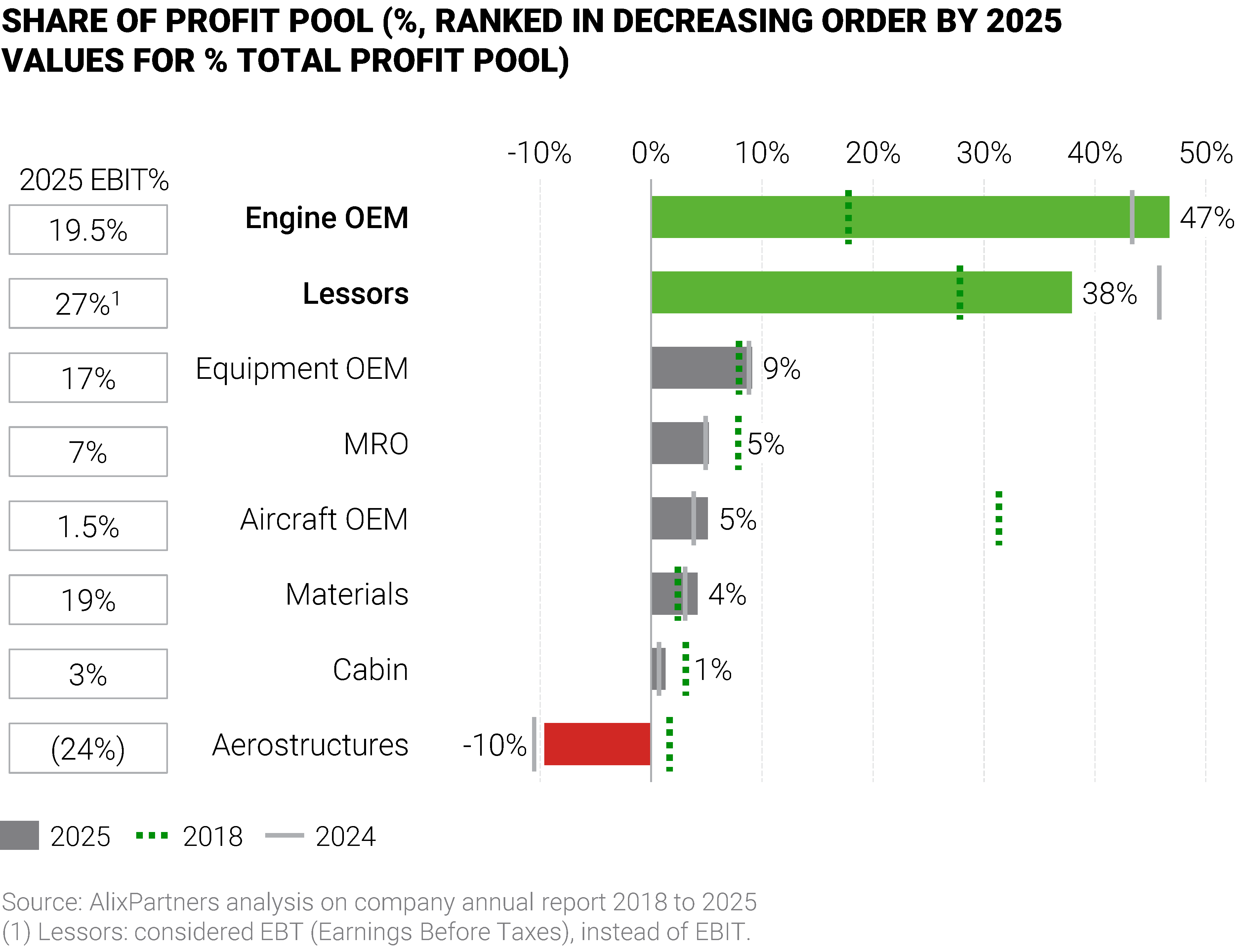
The profit pool winners and losers in 2025 mirror those of the previous year. Engine-makers and lessors captured 85% of industry earnings, which climbed 19% from a year earlier to $38 billion. Aircraft OEMs remain near break-even, while aerostructures suppliers are still mired in losses.
So 2025 marks a victory lap rather than a turning point, for now.
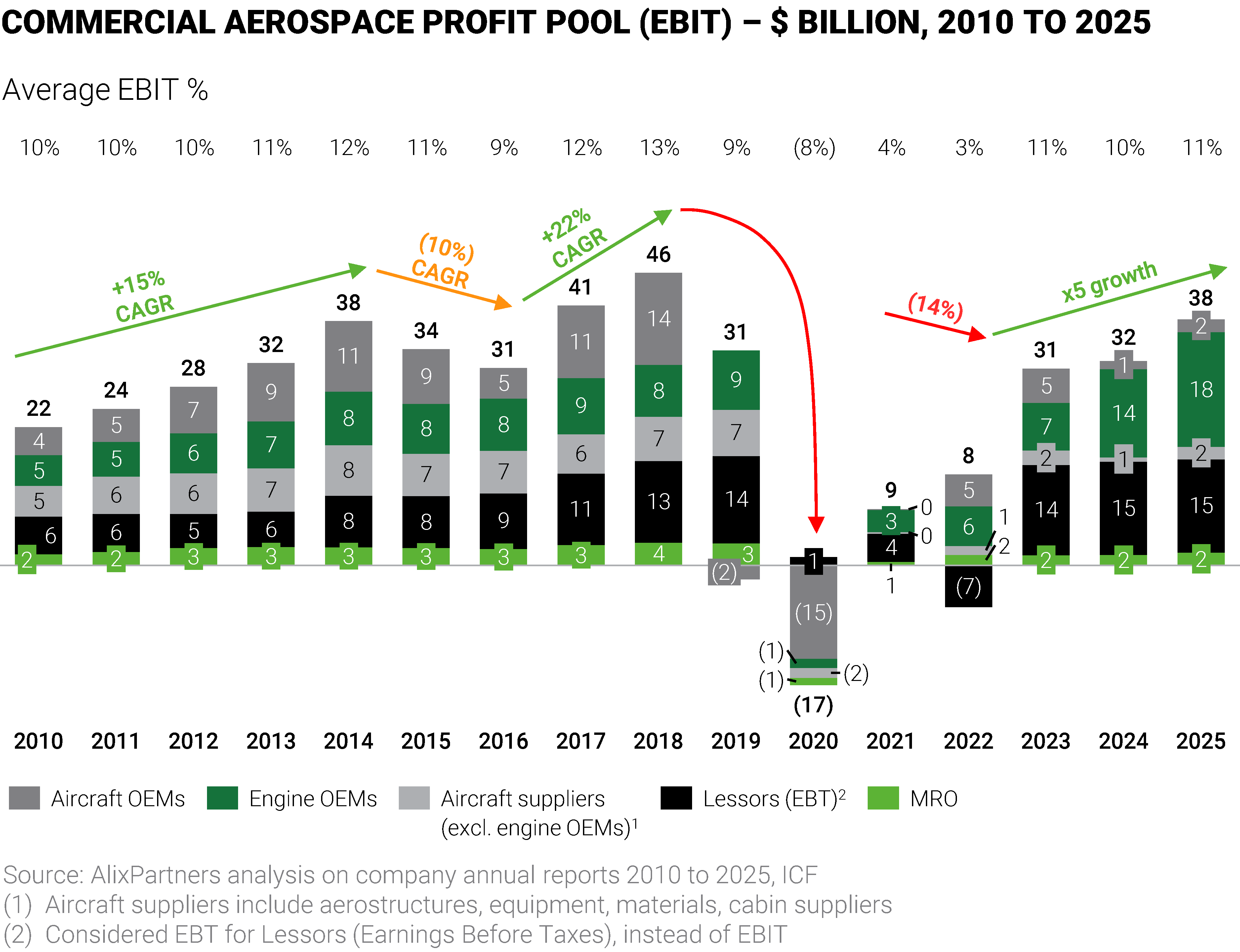
The dominant engine OEMs - GE Aerospace, Safran, Pratt & Whitney, Rolls-Royce and MTU - secured 47% of the commercial aerospace profit pool last year with a record 19.5% margin, well above pre-pandemic levels. Global revenue passenger kilometers rose 5.3% in 2025, lifting profits as shop visits soared.
While engine OEM margins look outsized, they should not be viewed in isolation from the risks these players took in developing their current powerplants. GE Aerospace invested more than $10 billion in the GEnx and GE9X, CFM International more than $5 billion in Leap development, and the Rolls-Royce Trent XWB cost an estimated $5.4 billion.
The bets made when outcomes were anything but certain are now paying off at scale. The current margin expansion is not just aftermarket leverage; it is the compounding return on years of patient capital deployment.
The aircraft leasing sector remains the second-largest earner, capturing 38% of the industry profit pool, with margins above 25%. Lessors have sustained those through the post-COVID-19 rebound thanks to persistent delivery backlogs, strong airline demand and constrained fleet supply.
Yet some pressure is starting to emerge. Lease rates are finding a ceiling, and once OEM delivery rates normalize over the next 2-3 years, the supply scarcity underpinning today's economics will moderate. Sustained high fuel prices could push more carriers into financial trouble, and stressed airline credit is the channel through which lease economics can crack.
Aircraft OEMs remain stubbornly close to breakeven with earnings before interest and tax of just 1.5%. Boeing's ongoing recovery was offset by Airbus' margin pressure from ongoing ramp-up costs. Aerostructures as a whole were structurally loss-making for the fifth consecutive year, nursing a negative margin of 24%.
Maintenance, repair and overhaul is approaching historical margins of around 7%, equipment OEMs hold double-digit margins around 17%, and cabin suppliers are finally consolidating their recovery but remain stuck in low-single-digit margin territory. None can rival the returns of the engine and lessor franchises.
The Middle East conflict has dented global airline traffic growth and spiked jet fuel prices, but the structural protections around the aftermarket are intact. Engine shop visit turnaround times remain extended, and slots are scarce. The in-service fleet is older than it should be because Boeing and Airbus production has yet to recover to 2018 levels.
GE Aerospace flagged in July that growth in flight departures is expected to return in the second half of the year after being broadly flat during the first six months. AAR in May bumped up its fiscal 2026 organic sales growth forecast by 100 basis points to around 12%.
A key watch item is whether sustained demand softness will drive up retirements, the only scenario that genuinely weakens the engine and heavy MRO moat. Historical precedent allows for a one-year lag, which pushes that pressure window into 2027.
Lower supply chain tiers are also a factor. Profitability among thousands of smaller players is mixed, although their liquidity to invest to ramp up is a larger issue, since OEMs are paying them more promptly after having pushed payment terms over 120 days.
The structural read is this. The divide is not closing. Investors have voted: commercial aerospace outperformed the S&P 500 by 11% over the past five years, but the return was driven by suppliers and lessors, not OEMs at the top of the pyramid. The engine-makers earned their dominance through capital risk and the long game.
The test of 2026 will be whether that dominance holds through a real macro shock. Our reading of the operating data suggests most of it will.
The analysis shows where value sits today and provides a path to where it will sit tomorrow. For suppliers outside the core of engines and lessors, the question is not whether the divide is real, but which levers can redistribute profits? They split into moves that companies can make now and the rebuild that pays off over the next program cycle.
Direct material is the fastest lever available, and the least used through the recent delivery-constrained years. Prices have climbed sharply since the pandemic—some categories, fasteners among them, now run two to three times their prior levels—yet most players have not executed a genuine cost-out in nearly a decade.
The capability gap is generational: an entire cohort of buyers has never run one. Executed correctly, procurement is structural rather than transactional. A credible make-or-buy position, backed by a real willingness to move volume, resets the terms of trade: it is never only about price, because the design authority it establishes sets the ceiling on every downstream aftermarket dollar.
Companies moving now are compounding an advantage their rivals will recognize only later, when they are undercut on a bid or watch their margins slip while others hold.
The aftermarket is where margin actually lives, and in most subsystems the component designer keeps all of it through a razor-razorblade model: the profit is in the parts, not the service.
Climbing the control curve is the clearest route back to a share of that stream. The curve resolves into four discrete positions: line-fit only, where the supplier keeps the entire aftermarket; selective participation as a reseller; active control, setting spares pricing and certifying the repair network; and full integration, owning MRO execution and pool economics. Each step up requires capital and certification that the step below does not, which is why most players stall at the second.
Proprietary content—PMA and DER—lowers the operator’s cost of ownership while building a moat around the installed base. Two levers remain underplayed: repricing and reclaiming volume as suppliers’ spare-parts licenses lapse, and converting the fleet data already generated into predictive, condition-based service.
Tier-2 and Tier-3 suppliers and the materials base now out-earn the primes above them, and the design authority, IP, and data rights fixed at nomination decide who collects lifecycle value.
Reintegrating high-margin content, stepping up from components to subsystems, and taking a position in the scarce base of castings, forgings, and materials all move a player to the profitable side of the pool. Two cautions apply. The obvious one is technical atrophy—capability, once ceded, is slow and costly to rebuild. The less obvious one is structural: these nodes are highly concentrated, so entry means either buying in or engineering around an incumbent.
AI tools employed across design, production, and sustainment, matched by automation on the floor, have moved past the pilot stage. It is how the front-runners fund the cost-out and reach the productions rates the next cycle will demand. Increasingly, it is the line that separates them from the rest.
All of it is worth doing now, the cost lever most of all after years of price increases. On their own, though, these tools redistribute profit along the chain more than they change where a player sits in the pool; position is a design question, and a longer game. The more durable prize is the data itself. Securing data rights and software access is what allows a company to own predictive, condition-based maintenance rather than surrendering it to the component OEM.
None of this reduces to a single lever. It is a supply-chain design question that plays out over decades, and it turns on where a company lands across a set of trade-offs: IP control, vertical integration, aftermarket participation, and data rights on one side; non-recurring cost and program risk on the other. That is where the pool genuinely shifts.
Put simply, the margin lives in the aftermarket, and supply-chain design is how a company decides who keeps it.
On the next single-aisle, value capture is decided at launch: engine architecture, material choices, control points, and above all the shape of the supplier contracts. Settle it well and a position holds for a generation; settle it late, once the program is running, and the economics belong to someone else and are hard to reverse. At component / sub-system level, the realistic outcomes are few: no change; a technology shift that opens a window to reset the split before the next platform’s economics lock in; a lifecycle trade, funding part of a supplier’s investment for a share of the return; or a direct counter to a supplier that is over-extracting, through dual-sourcing, insourcing, or IP leverage.
The pool will not redraw itself. The programs that will reset it are being scoped now, and the positions locked in at launch will set the next generation’s economics. AlixPartners works alongside airframers, engine and equipment OEMs, suppliers, and investors to build the make-or-buy positions, aftermarket strategies, and supply-chain designs that determine which side of the pool a company ends up on.
Eric Bernardini
Executive Partner & Managing Director, Global Co-Leader, Aerospace, Defense & Aviation
[email protected]
Stefan Ohl
Global Co-Leader, Aerospace, Defense & Aviation
[email protected]
Etienne Muselier
Partner & Managing Director, Americas Leader, Aerospace, Defense & Aviation
[email protected]
Matteo Peraldo
Partner & Managing Director
[email protected]
James Ellis
Director
[email protected]
Ivan Rodon
Director
[email protected]
Juliette Bruyere
Vice President
[email protected]