
Patrick Widmaier
Partner & Managing Director - Dusseldorf


In August 2024, we published an article examining the structural challenges facing the European steel industry. After highlighting demand contraction, sustained margin pressure, and rising competition from imports, we concluded that European producers needed to shift away from standard commodity products towards higher‑margin, specialized grades.
Since then, another factor has become increasingly prevalent: the underlying high-cost structure. European steelmakers today face a steeper increase in energy prices and labor costs, and tighter environmental and carbon regulations than many of their international competitors.
While this affects the entire value chain, the impact varies from stage to stage. European steel producers need to understand the key developments, and where those energy and labor costs are concentrated, before they can become truly competitive.
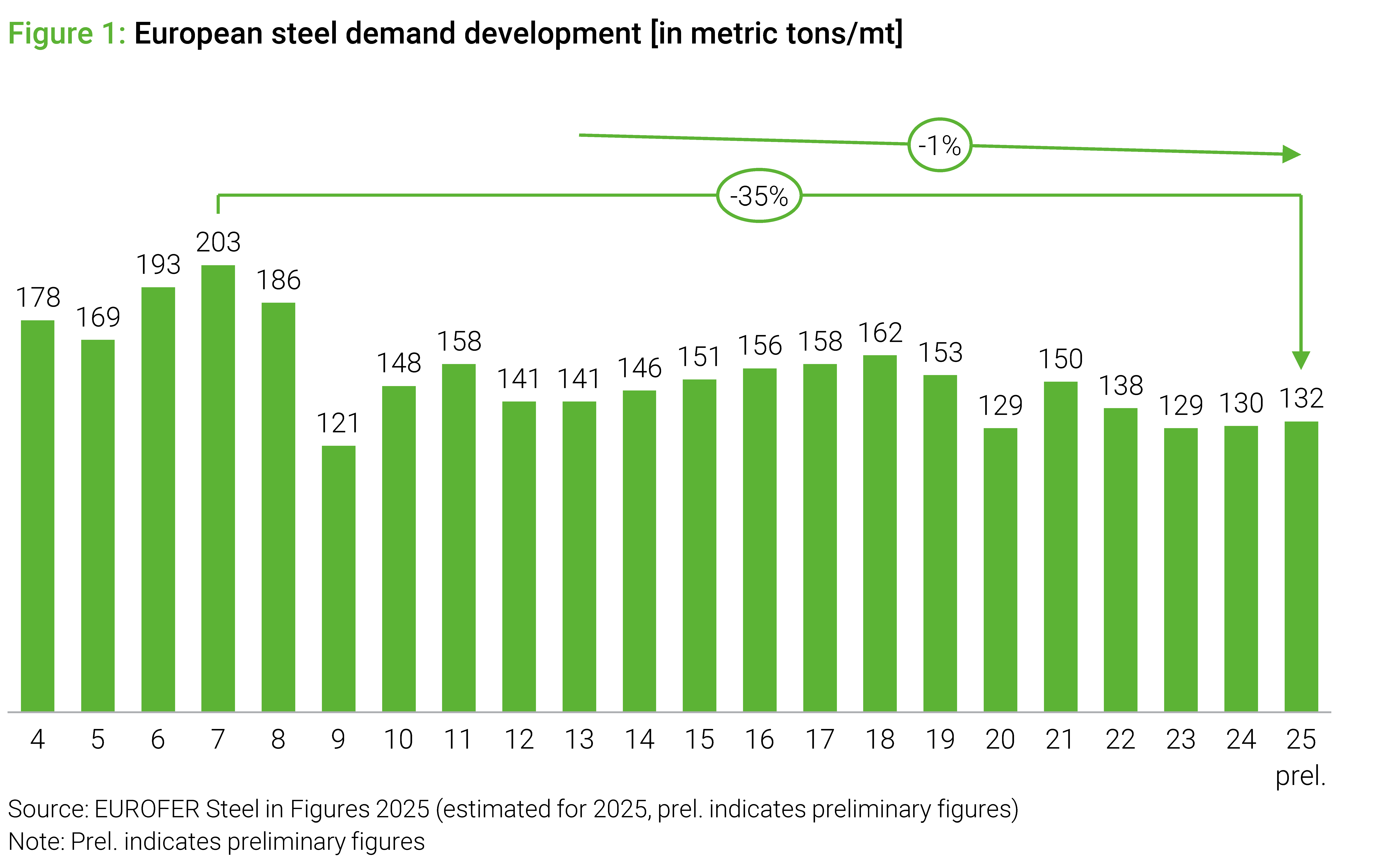
Our 2024 analysis showed a 36% decline in demand from the peak levels of 2007, and the latest data confirms a continuation of this trend. European steel consumption reached 132 million tons, up 1.5% from 2024, but still significantly below pre-pandemic levels.
Sectoral weakness has intensified in the following areas:
Hot rolled coil (HRC) prices have been extremely volatile in recent years. But it is important to note how, prior to the COVID-19 pandemic, they maintained a consistent similarity across North America, Asia and Europe. Since then, the gap has widened dramatically, including a sharp rise in U.S. HRC prices from late 2020 to early 2022.
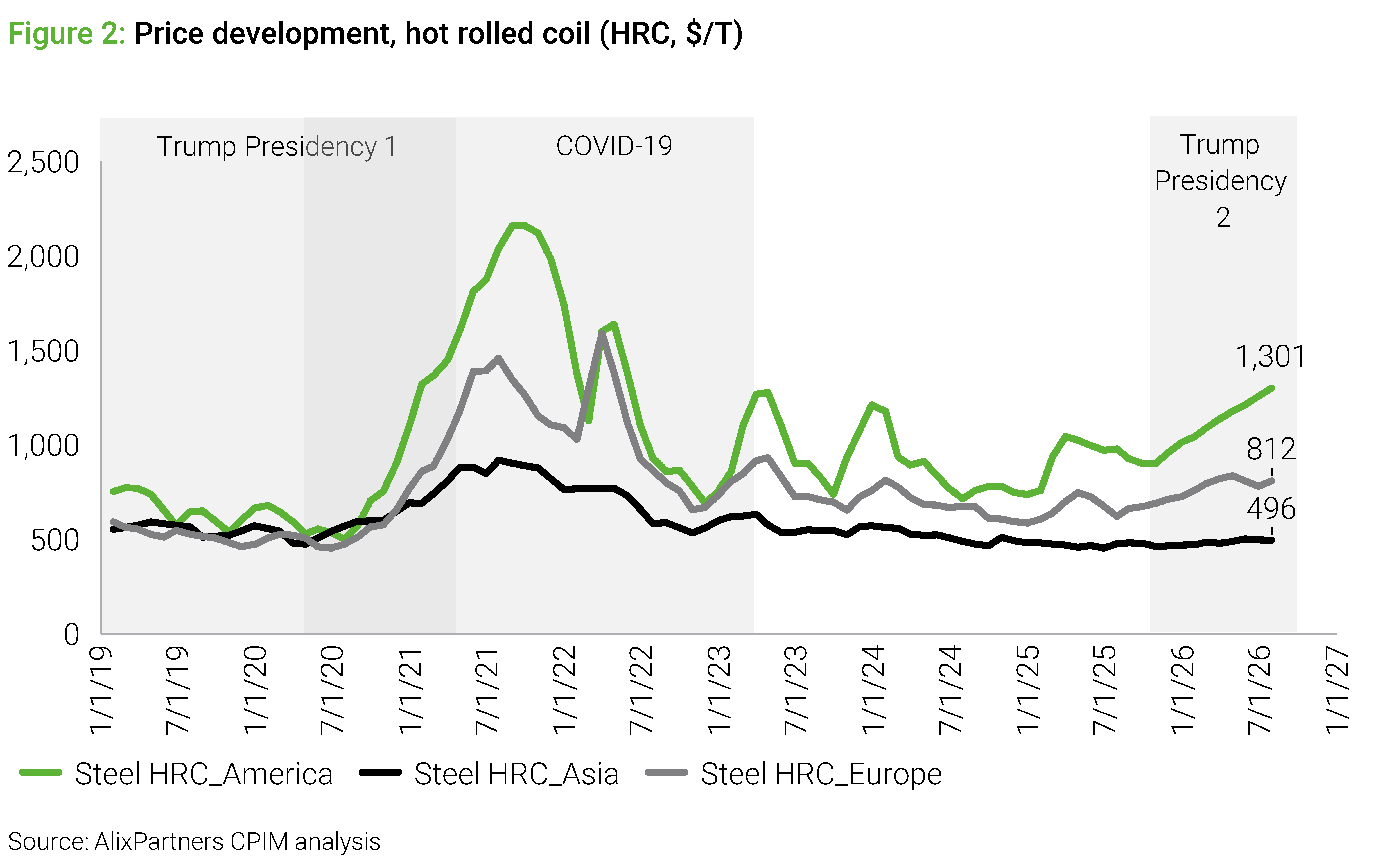
As of July 2026, hot rolled coil prices stood at:
Europe currently trades at a 38% discount to North America, while commanding a 64% premium over Asian pricing. This creates a difficult competitive environment for European steel producers: they face higher energy and labor costs than Asian competitors, while lacking the trade protection available to those in the U.S. As a result, they must overcome inflexible pricing in commodity segments, and persistent margin pressure.
With U.S. tariffs redirecting global flows, the U.S.-Europe gap has widened, and Europe must now contend with intensified import competition from Asian producers who seek alternative markets for volumes previously destined for the U.S.
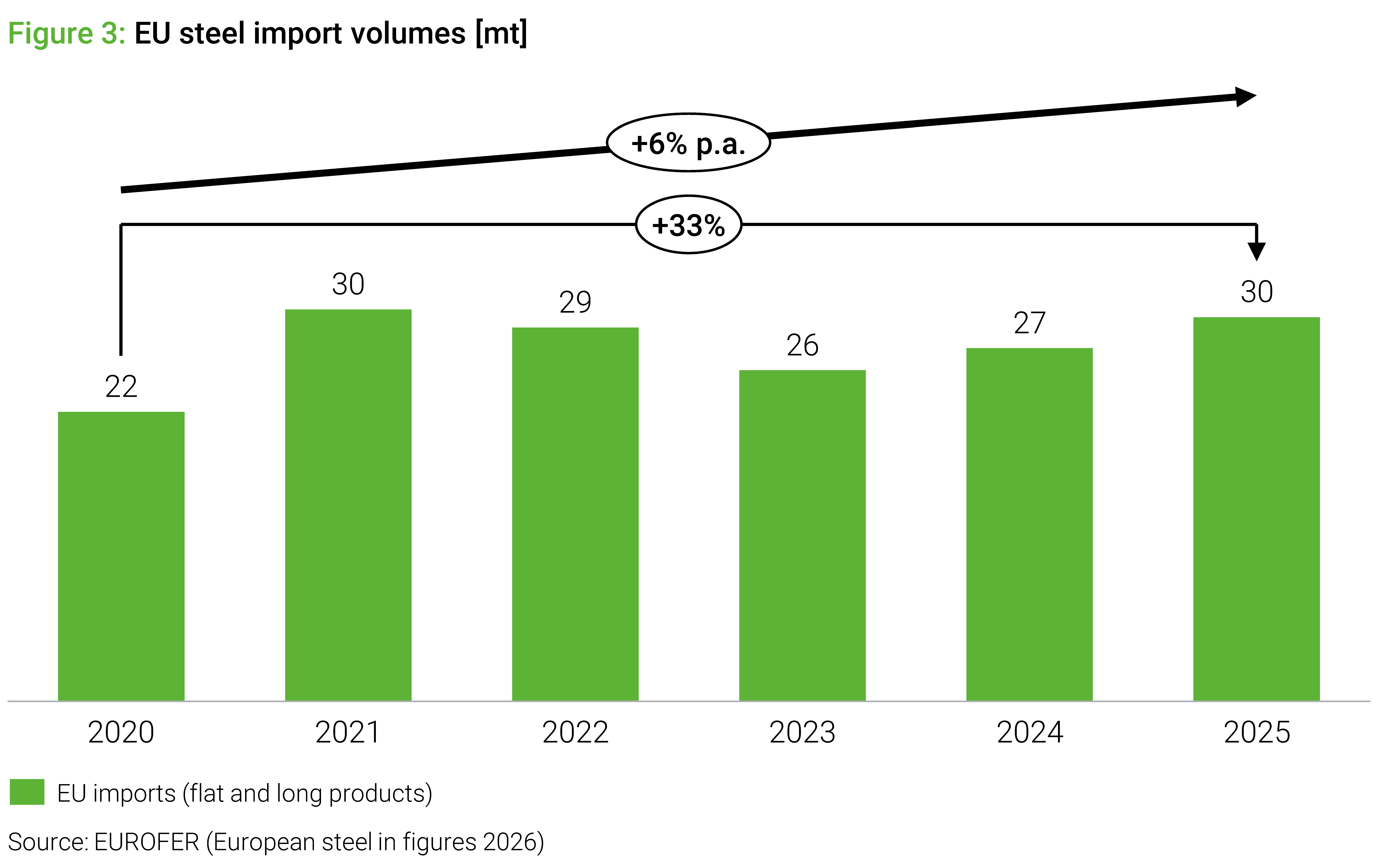
Import pressure accelerated sharply from 2020 to 2025. Total EU steel imports rose by approximately 33% (CAGR 6%) and 9% year-on-year from 2024 to 2025, reaching 30 million tons.
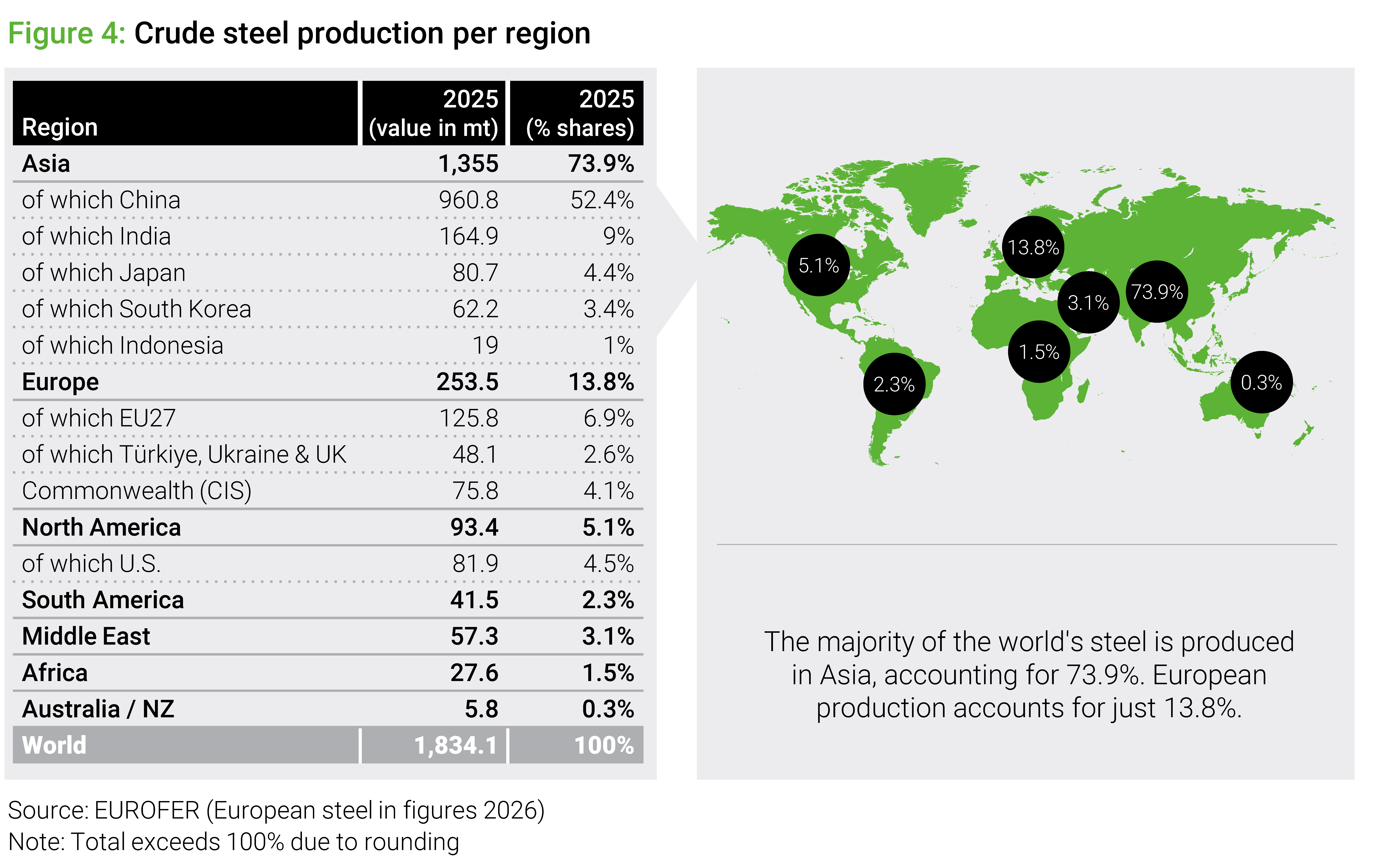
China accounts for 52.4% of global crude steel production (960.8 million tons of the 1,834 million tons produced globally in 2025). Chinese domestic demand, however, continues to contract, due to structural shifts in the real estate market and infrastructure investment patterns. Chinese steel exports reached 131 million tons in 2025, an all-time high.
One important factor underlying China's export patterns is the debt position of its local governments and state-owned enterprises. China's overall debt-to-GDP ratio reached approximately 290% by the end of 2024, with official local government liabilities estimated at around 48 trillion RMB, to which off-balance-sheet obligations through local government financing vehicles can be added. The resultant financial pressures drive continued export activity, in order to generate cash flow and maintain employment.
The composition of EU steel imports has shifted. The EU imported 29.7 million tons in 2025, and China dominated with 56%. This reflects the continued impact of anti-dumping measures.
However, total imports from Asia and proxy exporters remain dominant, as illustrated below:
This diversification reflects both capacity relocation and tariff circumvention strategies, making the competitive challenge more complex than when trading directly with China alone.
The turbulent transition to electric vehicles has significant implications for European steel producers. Despite a partial rebound, European light‑vehicle production volumes in 2024/2025 still remain below pre‑pandemic levels, limiting the scope for a strong recovery in automotive steel demand.
At the same time, the OEM profitability picture deteriorated in 2024, with Stellantis, BMW and Mercedes-Benz all reporting a drop in margins (of 80%, 32%, and 28%, respectively). These pressures cascade through supply chains as cost‑reduction programs intensify. Battery‑electric vehicle program delays by German OEMs averaged 245 days in 2024, up from 53 days in 2023, while ongoing lightweighting trends continue to limit steel intensity per vehicle.
Faced with these hurdles, the automotive segment offers only limited near‑term relief for European steel demand—even as it remains one of the core outlets for European specialty flat products.
Construction, which today accounts for around 35% of total European steel consumption, has seen by far the largest absolute reduction in steel demand since 2019. The combination of higher interest rates, stricter financing conditions and weaker residential and commercial activity continues to weigh heavily on volumes, particularly in Germany and several Southern European markets. As a result, even construction offers little near‑term support for a recovery in flat and long steel demand.
EU steelmaking capacity stood at approximately 193–195 million tons in 2025, continuing a long-term contraction from 236 million tons in 2008. That is a reduction of around 18% over 17 years. EU crude steel output fell to a new historic low of 125.8 million tons in 2025, down from 130 million tons in 2024. Implied capacity utilization dropped to approximately 63–65%, remaining marginally lower than the 65.4% recorded in 2024, and well below the historical healthy operating range of 70–75%. This shows that structural overcapacity remains deeply entrenched, even as facilities continue to close.
With realistic medium-term demand of 132–134 million tons, the implied overcapacity buffer stands at 60–65 million tons, roughly double the entire annual output of Germany and France combined.
From an economic perspective, steelmaking can be divided into three stages:
In a high‑cost region such as Europe, this distribution is important. Stage 1 accounts for the largest share of energy and labor exposure, while stages 2 and 3 offer more levers to offset high factor costs through product mix and technical capabilities.
For Europe, and particularly its high‑cost countries like Germany, the issue is clear: locating large volumes of stage 1 crude steel and slab production in the region with the highest energy, labor, and carbon costs means focusing the most cost‑sensitive part of the chain precisely where the structural disadvantages are greatest.
Concentrating European assets on rolling and further processing of higher‑grade, specialized products is more consistent with the cost position and with the capabilities of many European producers.
The data suggests that several factors from our 2024 analysis have become even more pronounced:
Taken together, these developments—weak demand, constrained pricing, persistent overcapacity, and a cost structure that is most exposed in stage 1 production—define the starting point for strategic action.
Europe cannot profitably maintain all stages of the traditional integrated steelmaking model for all products. Stage 1 crude steel and slab production is most exposed to the region’s high energy, labor, and carbon costs, while stages 2 and 3 offer more scope to offset these costs through product mix, quality, and proximity to demanding customers.
Against this backdrop, our 2024 recommendations remain valid but require sharper focus and faster implementation:
Cost discipline and operational efficiency remain critical, but they need to be aligned with new value‑chain logic. Capacity reductions and temporary shutdowns should primarily target high‑cost stage 1 assets producing commodity grades, rather than dilute returns by cutting into profitable downstream activities. Steps are being made in this direction—note the planned reductions at integrated sites in Western Europe—but overall adjustment remains incomplete.
European steelmakers should focus their long-term investment and capabilities on the parts of the value chain where structural disadvantages, such as energy and labor-intense value creation, are limited and where sustainable differentiation is possible:
Stage 2: Advanced flat and long products with demanding mechanical properties for automotive, energy and industrial applications.
Stage 3: Coated, processed and component‑level solutions developed in close cooperation with OEMs and tier 1 suppliers.
Green and low‑carbon steel offerings, where regulatory developments and customer requirements allow for explicit pricing premiums.
These choices can be reinforced on two fronts. On the product side, ultra-high-strength steels (UHSS) and other specialty grades offer a route to defensible differentiation: their strength-to-weight advantages enable lightweighting in automotive and energy applications, support explicit pricing premiums, and draw on the metallurgical and application know-how already concentrated in Europe. On the technology side, targeted investment in modern production technology, electric arc furnaces in particular, can lower the energy and carbon exposure of the stage 1 capacity that Europe chooses to retain for strategic reasons, partially offsetting the region's structural cost disadvantage rather than competing head-on with low-cost commodity imports.
Germany and Italy, which together represent 44% of EU steel production, are particularly suited to act as centers for such specialized, higher-value production. In parallel, stage 1-related assets will adjust to local and strategic demands.
With utilization at around 63–65%, and medium‑term demand in the range of 132–134 million tons, structural overcapacity remains in the range of 60-65 million tons. The logical focus for capacity reduction is the high‑cost crude steel and slab capacity in stage 1 operations serving undifferentiated markets. Rationalization efforts should concentrate output into the most efficient remaining assets while protecting downstream rolling and processing capacity that supports high‑value products and close customer relationships.
For standardized, high‑volume products, European cost structures make it unsustainable to compete with Asia, which is operating at approximately 480–500 USD/t. Here, importing low‑cost commodity steel is economically rational. Persisting with uneconomic stage 1 production for such grades ties up capital and management attention and reduces the ability to invest in higher‑margin segments.
To restore acceptable returns, Europe must adopt a new role in the global value chain: less an integrated commodity producer, and more an application‑focused specialist.
This shift can be accelerated by cross-border consolidation, joint ventures and partnerships that provide access to cost-competitive stage 1 capacity, while also building scale and capabilities in specialized stage 2 and stage 3 segments. The objective is not to maximize volume, but to build robust platforms for high-value, technically demanding products within Europe, to serve local markets and/or strategic autonomy considerations, such as the defense industry.
The structural challenges identified in our August 2024 analysis remain unchanged, but the latest data sharpens the priorities. Faced with a weak demand environment, sustained import pressure, and a structurally higher cost base, European steelmakers must be more selective about where they compete.
You can read the report below or download a copy.