People

A follow-up to What AI shopping agents will mean for customers and retailers.
E-commerce’s next evolution: LLMs and shopping agents
Leveraging AI and automation in e-commerce has quickly become table stakes. Most retailers are already using AI to reduce manual work, accelerate content creation, and improve operational efficiency. However, a new era is already underway, one driven not just by automation, but by large language models (LLMs) and AI shopping agents that are reshaping how products are discovered, evaluated, and purchased.
Historically, retailers targeted different customer segments and missions, but these audiences shared one defining characteristic: they were human. That assumption no longer holds, and the distinction goes beyond identity. Human shoppers browse, respond to emotion, and are influenced by storytelling, design, and experience. AI agents, on the other hand, do not. They query, parse, and compare based on structured data and explicit criteria, making decisions that no amount of visual merchandising or brand narrative can directly influence.
The rise of dual-customer commerce
With LLMs and shopping agents increasingly mediating interactions between retailers and consumers, e-commerce is no longer designed for a single audience. Retailers are now serving two decision-makers at once: human shoppers and the AI systems acting on their behalf. This emerging reality can be described as dual-customer commerce, where success depends on meeting the needs of both audiences at once.
The urgency is real. 38% of consumers have already used generative AI for online shopping, and over 70% of those users now rely on it as their primary source of product research. Retailers that are not visible to these systems are not losing ground gradually; they are being removed from consideration entirely, before a customer ever makes a conscious choice.
This shift does not eliminate the need for compelling storytelling or strong brand expression; these remain essential for human shoppers. But it adds a new and separate requirement for the AI systems increasingly making or influencing purchase decisions on their behalf. Product content, data, and site architecture must now be interpretable not only by people, but also by machines that crawl, evaluate, compare, and recommend products before customers visit a site.
The question for leaders is no longer whether AI will reshape e-commerce, but how well their organisation and digital ecosystem are equipped to operate in this dual-customer environment, and how quickly they can evolve as discovery becomes increasingly AI-mediated – where AI systems influence what customers see, compare, and consider before they ever visit a retailer’s site.
The new digital shelf: A practical maturity curve for AI-driven e-commerce
Winning in an AI-mediated e-commerce environment does not require a single, disruptive leap. Instead, it requires progressing through a set of foundational, then increasingly strategic, capabilities that retailers already control – from how product data is structured, to how content is created, to how e-commerce systems interact with LLMs and shopping agents.
The maturity curve outlines this progression. While many retailers will recognise elements of all three stages today, this clarifies the capabilities that must be in place to advance and where leadership attention and investment can deliver the greatest impact. We describe this as Crawl, Walk, and Run. Though presented sequentially, in practice, leading retailers advance these capabilities in parallel, building foundations while accelerating toward visibility and agent readiness.
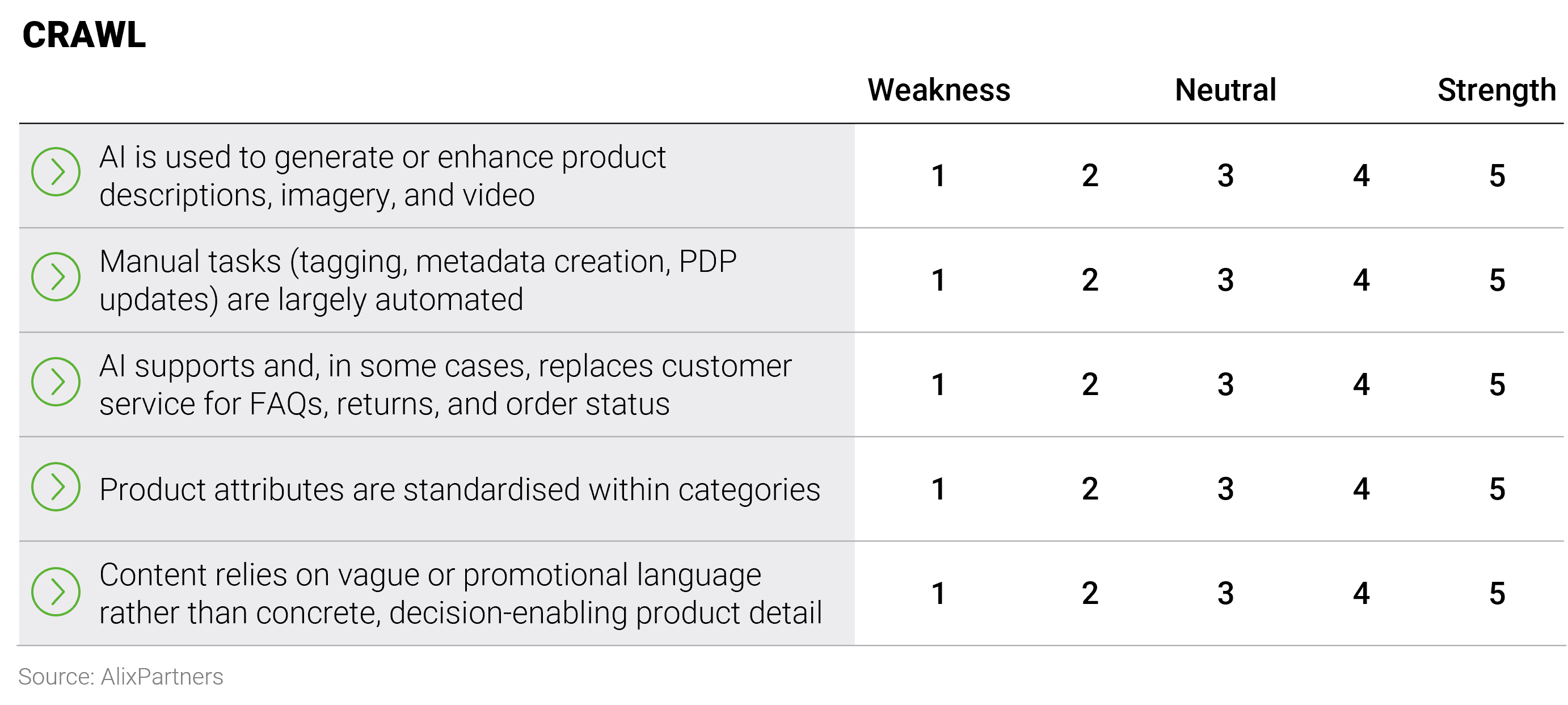
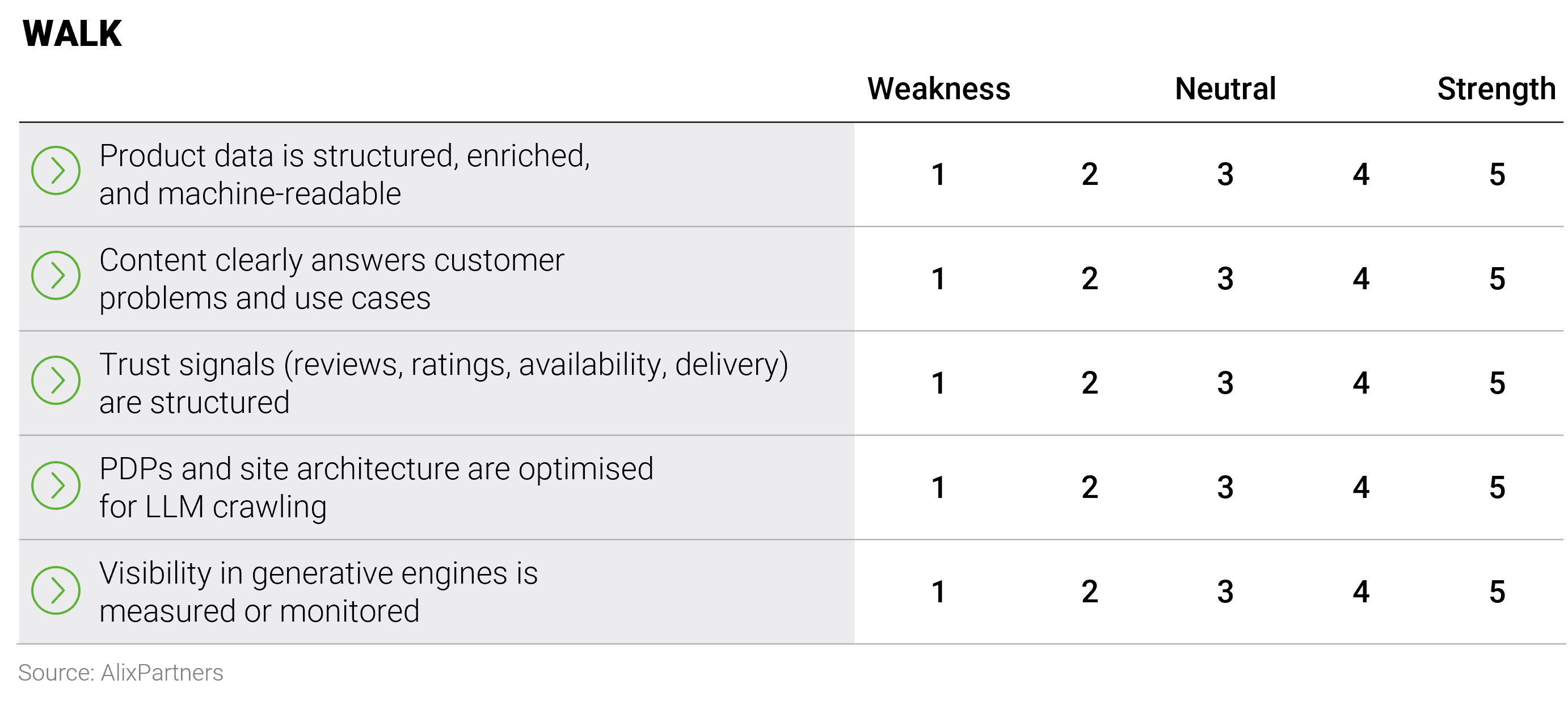
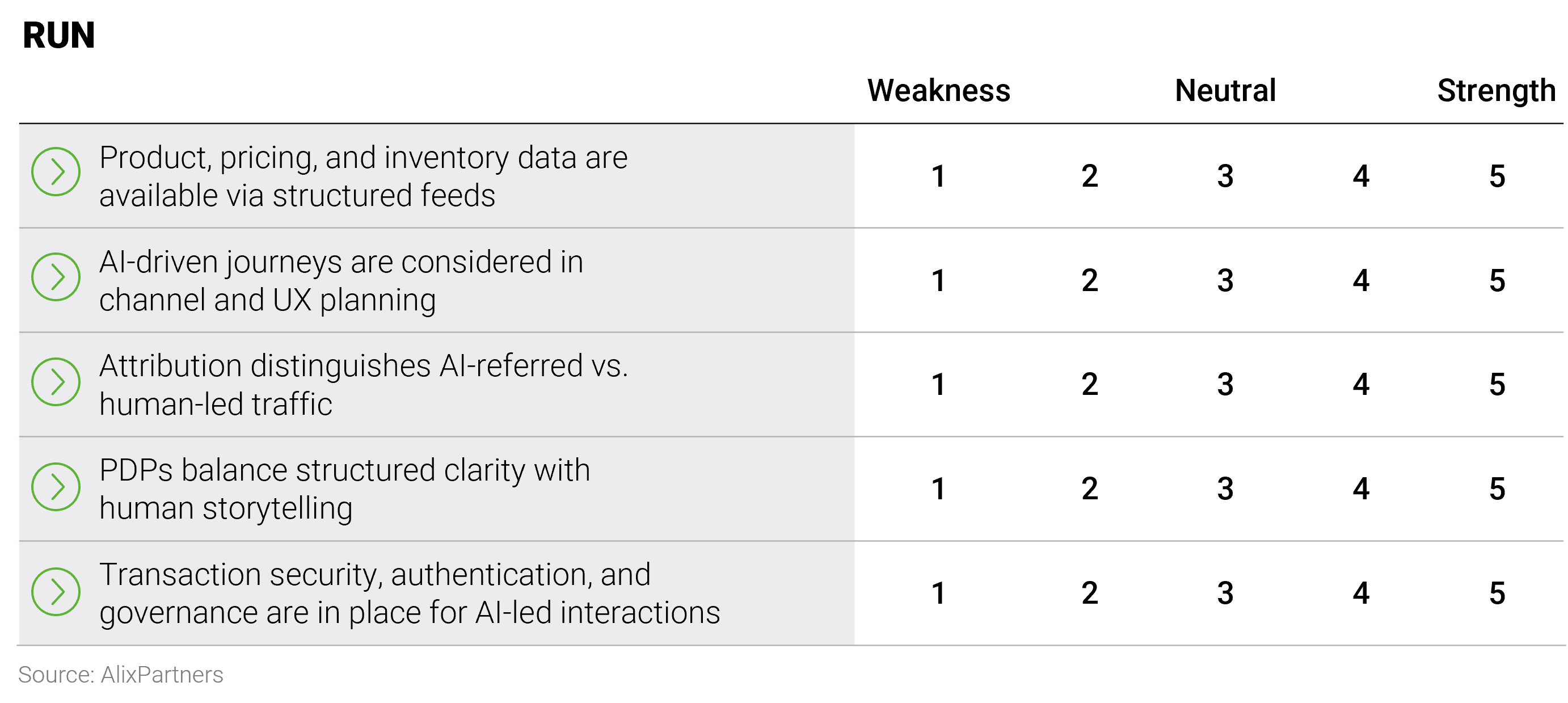
Each stage includes a brief self-assessment, enabling leaders to gauge where their organisation sits today and where targeted capability-building may be needed to move forward. |
Crawl: Using AI to make today’s e-commerce operations more efficient
At the Crawl stage, retailers apply AI to improve efficiency across existing e-commerce workflows. These actions are becoming essential, delivering reduced cost, accelerating execution, and improving consistency, while creating the foundational inputs required for more advanced AI visibility and readiness.
AI is applied to content generation, data maintenance, and service workflows to remove manual effort and increase speed. This includes AI-assisted product descriptions and imagery, automated tagging and metadata creation, and AI-supported customer service for routine interactions. While these initiatives are not yet designed to drive generative discovery, they create the foundational inputs – cleaner data, richer content, and better metadata – that later GEO efforts depend on.
Walk: Structuring content and data to increase visibility in generative engines
The Walk stage is where the majority of Generative Engine Optimisation (GEO) readiness is built. Here, retailers move beyond efficiency and deliberately optimise how their digital footprint is interpreted by LLMs and conversational interfaces that increasingly shape discovery, ensuring products can be accurately understood, evaluated, and surfaced by generative engines.
This shift mirrors an earlier evolution from traditional SEO, but with a critical difference. While SEO optimised for human search behaviour and keyword matching, GEO focuses on how AI models understand, summarise, and recommend products. Success relies less on keywords and more on structured data, clear resolution, and trusted signals that allow models to confidently answer shoppers’ questions.
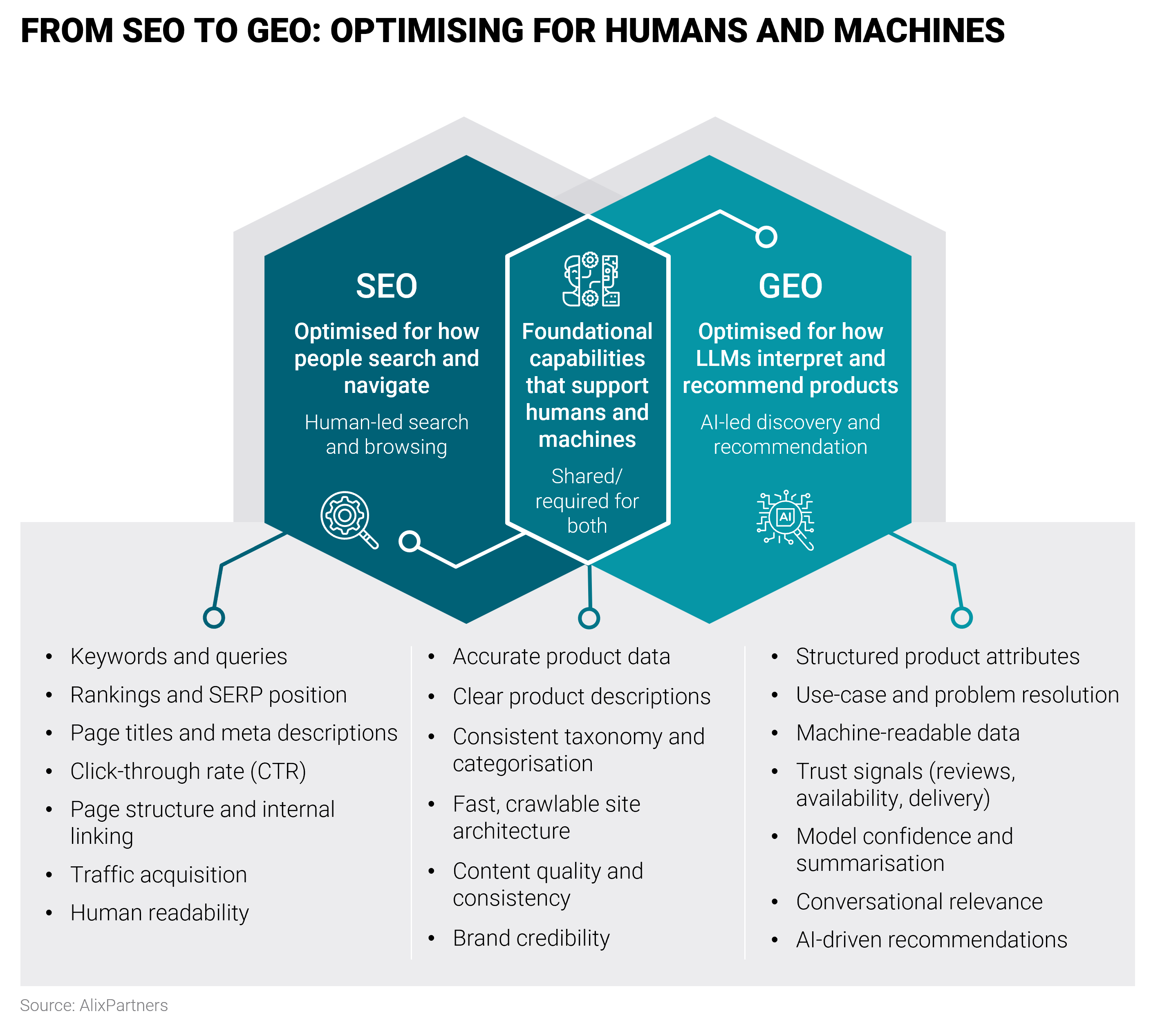
In this stage, product data and content are intentionally designed so that machines can determine what a product is, who it is for, when it should be used, and why it is relevant, often before a customer ever sees a product page. Retailers begin to monitor how they appear in AI-driven discovery, even as performance measurement remains largely anchored to human-led journeys.
Run: Enabling secure, transaction-ready, agent-led shopping
In the Run stage, retailers introduce new capabilities to support direct interaction and transactions with AI shopping agents. While these efforts build on the structured data, clear content, and trusted signals established in Walk, they go beyond GEO alone and require additional operational, technical, and governance considerations.
The focus shifts to enabling controlled, secure, and reliable agent interactions. This includes exposing real-time product, pricing, and inventory data, supporting transaction readiness as agents begin to initiate or complete purchases, and ensuring appropriate security, authentication, and safeguards as machines act on behalf of customers.
Security considerations here operate on two levels: technical protection – securing APIs, authenticating agent identities, and preventing unauthorised access – and commercial protection against agents explicitly programmed to exploit business vulnerabilities. Unlike a human shopper, an AI agent can systematically stack coupons, probe return and exchange policies for loopholes, or game promotional offers at scale, across thousands of transactions. Retailers will need controls, such as offering eligibility logic, transaction rate limits, and behavioural anomaly detection, to distinguish legitimate agent-assisted purchases from adversarial ones.
Retailers also begin to distinguish between human-led and AI-mediated journeys, adapting attribution models, channel planning, and UX design accordingly. Importantly, this stage is not about speculative futurism; it reflects operational readiness for shopping behaviours that are already emerging.
Conclusion: Winning the digital shelf in an AI-mediated world
AI is increasingly reshaping e-commerce. Discovery is no longer driven solely by human browsing, search engines, or on-site merchandising; it is increasingly influenced by LLMs and shopping agents that interpret content, compare options, and guide purchase decisions before customers ever reach a retailer’s site.
The maturity curve outlined in this article shows that adapting to this shift does not require a wholesale reinvention of e-commerce. It requires building the right capabilities in the right sequence. Efficiency-focused initiatives create scale and consistency. Visibility-focused actions, particularly in the Walk stage, determine whether products can be accurately understood and surfaced by generative engines. From there, retailers can add the operational and technical capabilities needed to support agent-led shopping interactions.
What is fundamentally new is who retailers are optimising for. E-commerce teams are now designing for both human shoppers and the AI systems acting on their behalf. This shift toward dual-customer commerce makes it essential that product data, content, and trust signals can be reliably interpreted by machines, not just experienced by people.
Retailers that act now will strengthen their digital shelf, protect visibility as discovery evolves, and position themselves to grow alongside shopping journeys increasingly influenced by AI. Those that delay may still appear competitive on the surface, but risk being deprioritised or filtered out by the AI systems customers increasingly rely on to discover and evaluate products.
The opportunity ahead for retailers is significant, but requires focus, sequencing, and intent. Understanding where your organisation sits on the maturity curve today is the first step toward building the capabilities that will define e-commerce performance in the years ahead.