
Steve DuBuc
Americas Leader of Sourcing & Procurement Transformation, Partner & Managing Director
Detroit
Steve DuBuc
Partner & Managing Director - Detroit


Procurement leaders are facing an endless cycle of disruptive forces. Challenges, including spiking input costs, are compounding as product margins evaporate. Responses designed for a world of stable trade flows and predictable commodity prices no longer work.
Outdated cost models do not accurately reflect the cost structure your procurement team currently manages. Procurement teams must shift from managing spend to understanding it in real time – at the component level and against competitor data.
While many product-centric organizations already have Design-to-Value (DTV) programs in place, most still suffer from the same organizational failures. Disassembly is an event rather than the first step in an intelligent system. After weeks spent taking the product apart, cataloging, and costing, companies realize that the next generation of the product is already in tooling. It's too late for the teardown results to have any meaningful impact. The findings sit with the engineers who ran the teardown, rather than with the team negotiating sourcing or with product teams who could use them to set cost targets.
Companies gaining ground on competitors while protecting margins are those that treat teardowns as the front end of a continuous cost intelligence pipeline. Instead of starting from scratch with each teardown, teams can assess comparability across product families and track their competitors’ cost structures over future generations. The pipeline builds with each new cycle, creating a living data asset that grows in value over time.
The intelligence in the pipeline comes from the transformative power of AI, which digitizes the war room activities. It contributes to three critical functions previously dependent on bottlenecked expert bandwidth:
Teardown intelligence drives the sourcing strategy. Should-cost evidence supports supplier negotiations while design-to-cost targets are embedded in the engineering brief. Make, buy, or partner decisions are made by accurately assessing competitor capabilities.
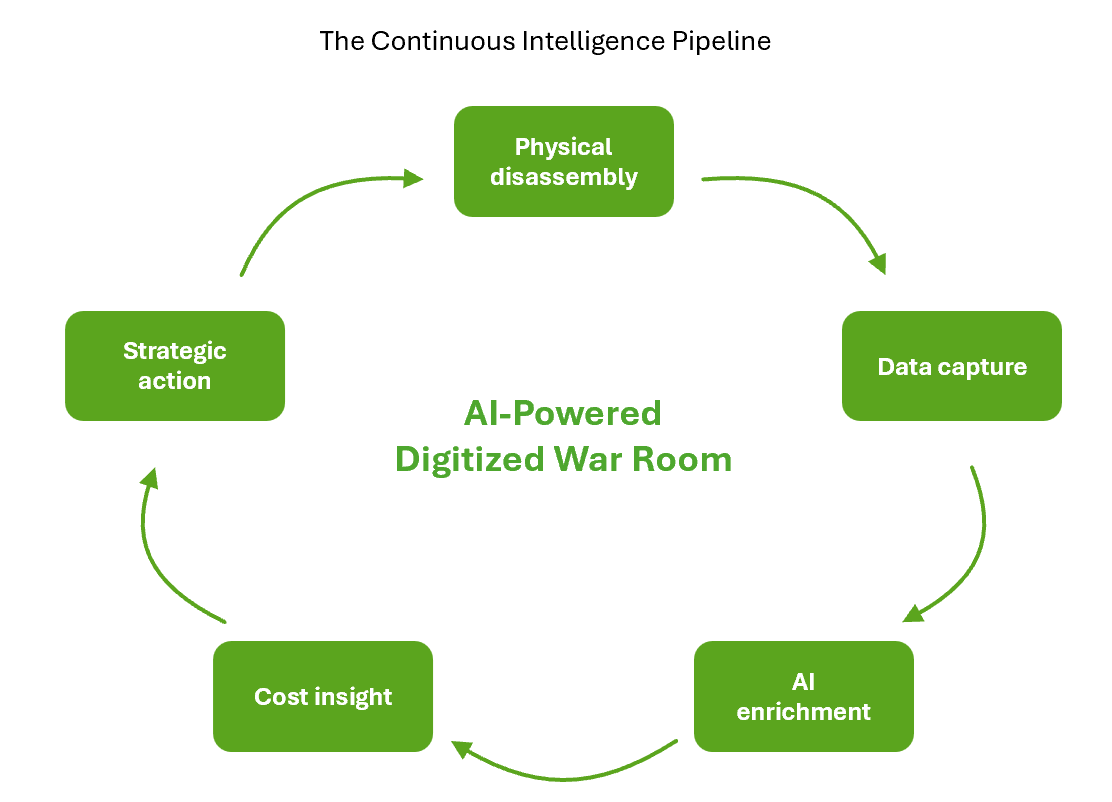
Dismantling the traditional silos that hinder information sharing is a critical first step. The talent model, which relies on the "teardown expert hero," is replaced by cross-functional teams that integrate specialists, including data engineers, procurement analysts, AI/ML experts, and design engineers. Team members from procurement and engineering will require training and aligned incentives to develop a common understanding of cost-related language.
Once these structural changes are in place, it’s time to begin building the intelligent pipeline by developing a pilot. This starts after an honest audit of current teardown maturity (how many products are analyzed annually, how findings are stored and accessed, and whether procurement and engineering use the same data or work from parallel systems) has been conducted.
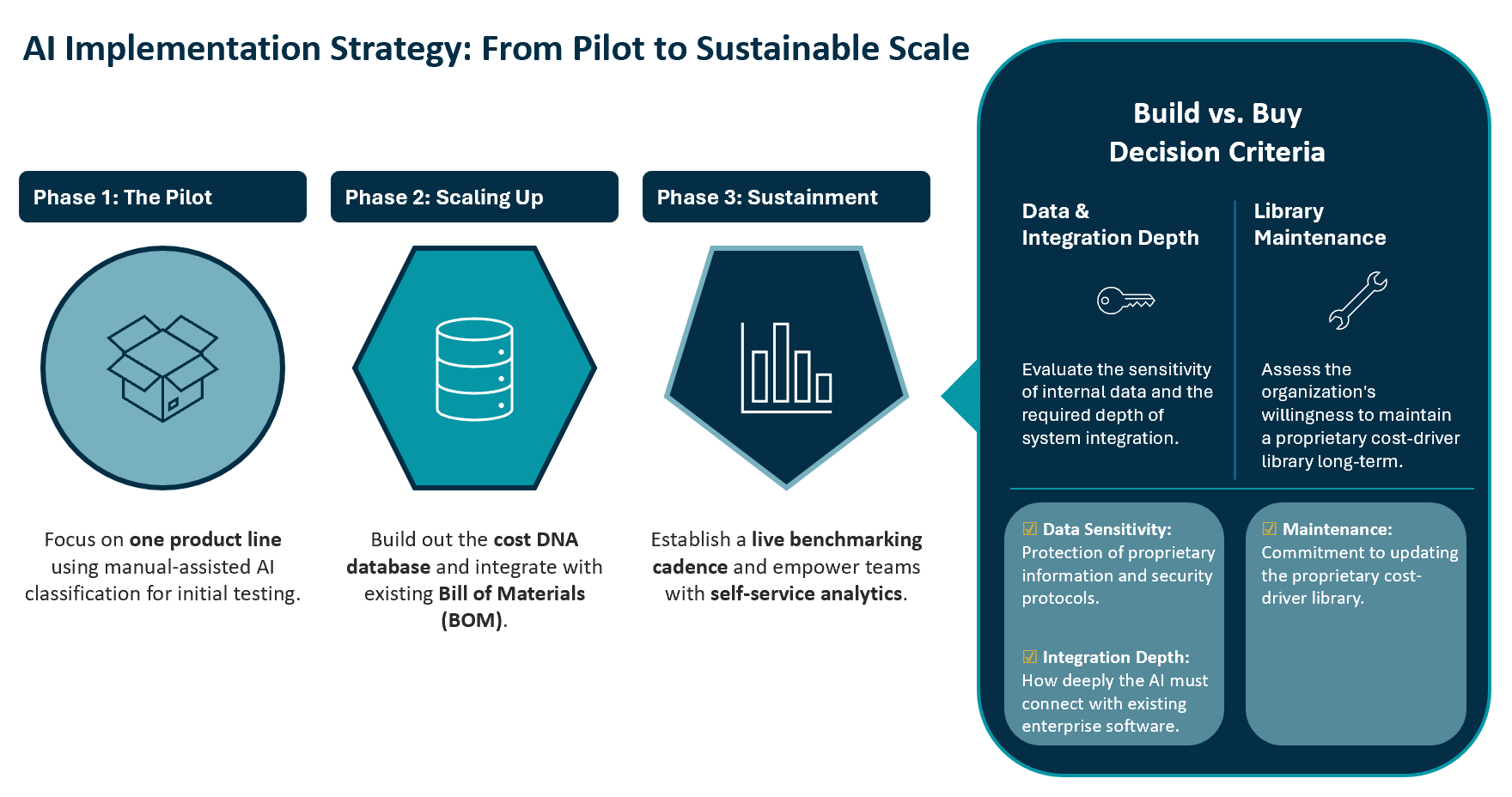
Select a pilot where the cost savings could be significant - a high-volume SKU facing margin pressure or a competitor’s product with a price you can’t match. Choosing a product familiar to the team will allow AI output to be validated against existing teardown data. Over six to eight weeks, a cross-functional pod consisting of an engineering lead, a procurement analyst, and a data engineer should deliver a should-cost teardown that identifies named-savings actions and shows the cost gap versus the competitor's analysis.
The pilot has four phases:
The build-versus-buy decision should be validated concurrently by the AI platform.
Scale only after the pilot proves three things: cycle time is meaningfully shorter, should-cost outputs hold up against actual supplier quotes, and procurement and engineering work from the same numbers. Then extend the configuration to adjacent product families, build out the cost DNA database, and shift live benchmarking into a standing cadence.
As the pilot scales, buy-versus-build choices become more clear-cut. Buying becomes the best move when value matters over differentiation, and the vendor’s cost-driver library supports your categories. Build becomes the optimal choice when the following apply: the teardown represents a core competitive capability, data sensitivity requires third-party hosting, or integration with a proprietary BOM or PLM system requires depth beyond existing vendor capabilities.
In the end, a hybrid approach often works best. This allows organizations to license the vision and classification layer, own the cost-driver library, and competitor benchmarking database.
Once the pipeline is operational, procurement teams start their work with a detailed view of how a competitor built their product for less, where sourcing can do better now, and the discussion quickly shifts to which ideas require value engineering support to implement. Competitive cost position becomes an executive KPI.
Recently, a leading industrial automation manufacturer faced a cost disadvantage relative to a competitor for high-volume parts. Using this framework, the pilot teardown identified 12% in annual savings through dual-sourcing opportunities on design-to-cost changes that maintained performance while reducing material cost. The findings reset the supplier negotiation baseline and informed the next-generation product specification.
Contact our experts to learn how we help companies facing margin pressure transform their teardown program into a durable, competitive asset.