
Edward Chua
Senior Vice President - Dallas


Funding for quantum technology is moving fast. Cumulative deal volume over the past three years has already surpassed what AI attracted a decade ago. In 2024, quantum startups raised $1.5 billion across 50 deals, nearly double the prior year's total. This surge reflects growing awareness of quantum’s disruptive potential. Computing and simulation get most of the attention. But the immediate threat is in cybersecurity.
The race to quantum, known as Y2K, highlights the pace of this technological evolution and the need to move to stronger encryption. Post-quantum cryptography (PQC) is becoming a strategic priority for companies in every industry because the encryption standards most organizations run on today were not built to withstand quantum-capable attacks.
Now may be the time for investors on the sidelines to explore opportunities in quantum technology. Recent M&A activity in quantum technology reveals a shift from speculative investment to strategic consolidation. Quantum companies are beginning to generate revenue; one of the largest recent deals was IonQ’s $54.5 million contract with the U.S. Air Force Research Lab to advance quantum networking capabilities. While revenue multiples remain difficult to benchmark, strategic buyers are increasingly focused on quantum capabilities.
Quantum computers work differently from the computers we use daily. They make clever use of two fundamental rules of quantum physics that govern the behavior of particles at the smallest scales (smaller than atoms): superposition and entanglement. The technical details are exceedingly complicated and out of scope for this article, but can be summarized by stating that qubits, the quantum analog to regular bits, which are the basic building blocks for all computing systems, can:
Be any combination of 0 and 1 simultaneously (as opposed to only 0 or 1, which is true for classical bits), i.e., a state superposition, allowing for a much greater amount of information to be stored and processed in a smaller number of qubits.
Affect one another instantaneously, which lets researchers efficiently process multi-qubit states, i.e., entanglement, which enables information transfer.
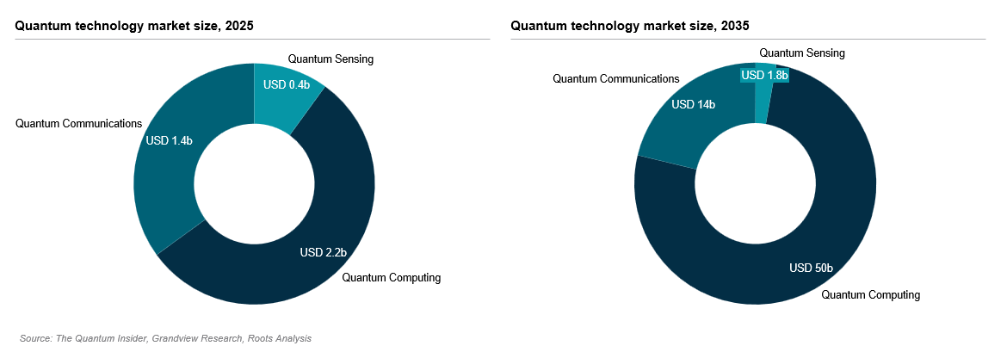
Exploiting these effects allows a quantum computer to store and process exponentially more information than a classical computer, which has led to the development of quantum technology. Quantum technology includes three key applications:
Quantum computing (QC): A new computing paradigm leveraging the laws of quantum mechanics to provide performance improvement for certain applications.
Quantum communication (QComm): The secure transfer of quantum information that can ensure the security of communication even in the face of quantum computing power.
Quantum sensing (QS): A new generation of sensors, based on quantum systems, that provide measurements of various quantities, e.g., electromagnetic fields, gravity, or time, that are orders of magnitude more sensitive than classical sensors.
The market share of these three technologies is projected to reach around $66 billion by 2035 (largely driven by quantum computing), representing substantial growth at an approximate 32% CAGR.
Below, we have created the following investment roadmap to guide how you approach value creation in the quantum space:
Quantum is moving from promise to inevitability. For private equity, the question is no longer whether to engage; it's where. The quantum landscape spans different domains, each at a different stage of maturity and each carrying a different risk-return profile. The opportunity is not to predict the ultimate winning technology, but to build informed positions across the layers that enable, secure, and commercialize quantum today.