
Mike Walsh
Partner & Managing Director - London


In our first article in this series, What AI shopping agents will mean for customers and retailers, we outlined six imperatives retailers must act on to stay competitive in a fast-evolving landscape. As of late 2025, Amazon had launched Buy for Me, Google had rolled out agentic checkout with Gemini, and OpenAI’s Instant Checkout had gone live with partners including Etsy, Shopify, and Walmart. 2026 has seen agentic e-commerce go mainstream, with the market expected to be worth $236 billion by 2034.
AI agents are reshaping where discovery happens
Customers are no longer beginning every online shopping journey by navigating multiple brand sites or sifting through search engine results. For some missions, the battleground is shifting away from historic rivals – such as Walmart vs. Target in the U.S., or Aldi vs. Lidl in Europe – and towards a small number of AI-mediated entry points such as ChatGPT, Gemini, Perplexity, and Amazon Rufus.
These are not interchangeable channels. Each starts from a different point and plays a different role in the journey. A brief run-down:
For most retailers, the answer is likely to be a portfolio of routes to visibility, rather than a single bet. A beauty or apparel brand may need to be discoverable in ChatGPT and Perplexity conversations; a replenishment-led or commodity business may need a stronger presence in Rufus and Gemini shopping flows.
There is, however, an important nuance here. As Alex Baldock, Currys CEO and incoming Boots CEO, argued at the 2026 World Retail Congress, agentic AI may amplify incumbent strengths such as trust, review depth, service reputation, and scale. That suggests the winners may not divide neatly into “branded” and “commodity” players alone: trusted omnichannel incumbents may also be well-placed.
A closer look at Amazon’s strategy
Amazon is positioning itself as more than just another AI entry point. Its strategy is to extend the Amazon interface beyond its own marketplace and turn it into a storefront for third-party retailers as well.
Through its Buy for Me feature, powered by Amazon Nova and Anthropic’s Claude, customers can use Amazon not only to search its own catalogue, but also to buy from third-party brand sites without leaving the Amazon interface. When a shopper selects an item hosted on a third-party retailer’s site, the agent navigates there on the customer’s behalf, adds the product to the basket, enters the shipping and payment details Amazon already holds, and completes checkout, all within the app.
For the shopper, the experience is close to buying a first-party Amazon product: one interface, one login, and one order to track. The retailer fulfils the order, but Amazon remains the customer-facing layer.
That matters because much of the friction of moving between brand sites, comparison tools, and separate checkouts disappears. Amazon, not the third-party retailer, becomes the single location for the full journey from research to decision to transaction completion. It owns the discovery surface, the decision point, and the transaction layer, while third-party retailers risk operating one step removed from their own buyers.
Amazon is also aggressively defending its position as the starting point for discovery. 63% of consumers begin their product searches on Amazon rather than on traditional search engines. When OpenAI threatened to take some of this discovery share, Amazon blocked ChatGPT, OpenAI’s LLM, from accessing Amazon’s product catalogue.
This is a more advanced version of the shift we identified in our first article: if customers cannot find what they want on Amazon, Amazon’s agent can now go into the broader web and buy it on their behalf. That is not simply an extension of marketplace commerce; it is a fundamentally new architecture.
Customers win on several fronts. They no longer need to monitor prices manually: Amazon’s Auto Buy feature lets shoppers set price targets, while Rufus monitors products and completes purchases automatically when thresholds are met. They may also save money in the process, with early evidence suggesting an average saving of 20% per purchase for Prime members using these tools.
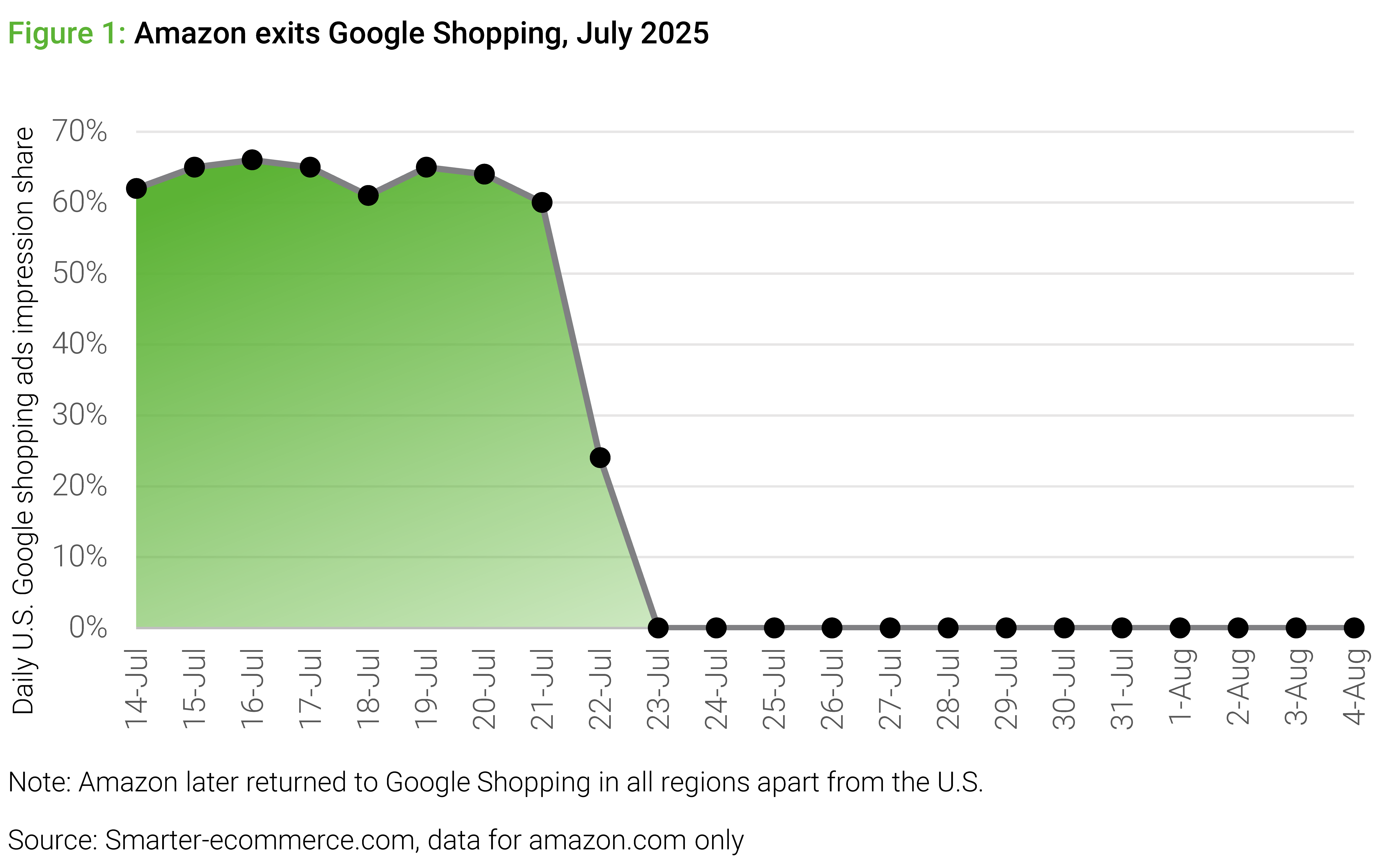
Amazon clearly believes in this strategy. In July 2025, it withdrew entirely from Google Shopping advertising in the U.S., a move that signalled confidence in Amazon as the primary gateway for product discovery. Although advertising later resumed in parts of Europe, it has not resumed in the U.S., and the strategic message was hard to miss.
The broader move away from traditional search is visible elsewhere, too. Gartner, for example, forecasts a 25% decline in global search traffic by this year as conversational AI replaces parts of conventional search behaviour.
Retailers risk being relegated to just a supply chain role
As discovery, evaluation, and checkout shift into agent channels, retailers risk being disintermediated from the customer journey, compromising the critical value of the direct customer relationship and, instead, being reduced to playing a supply chain role: fulfilling the order, but no longer owning the customer relationship.
That risk is especially clear in grocery, where players such as Instacart in the U.S. have already inserted themselves between customer and retailer. If a customer starts with a prompt such as, “I’m hosting a dinner party on Saturday, what do I need?”, the recommendation, curation, and transaction could all happen on ChatGPT via Instacart's checkout integration before any grocer meaningfully enters the conversation.
Retailers that fail to assert themselves in these journeys risk becoming invisible in their own category. We expanded on this in a previous article, The new gatekeepers: A perspective on how conversational AI could re-write the grocery value chain.
This pattern is most acute online, which matters because online has also been the richest channel for customer data. If retailers lose direct control of the digital journey, they lose visibility into behaviour, intent, preferences, and switching patterns. That makes it harder to segment, target, retain, and personalise. Physical stores remain powerful relationship assets, but the direction of travel online is clear.
Reinforcing the six imperatives
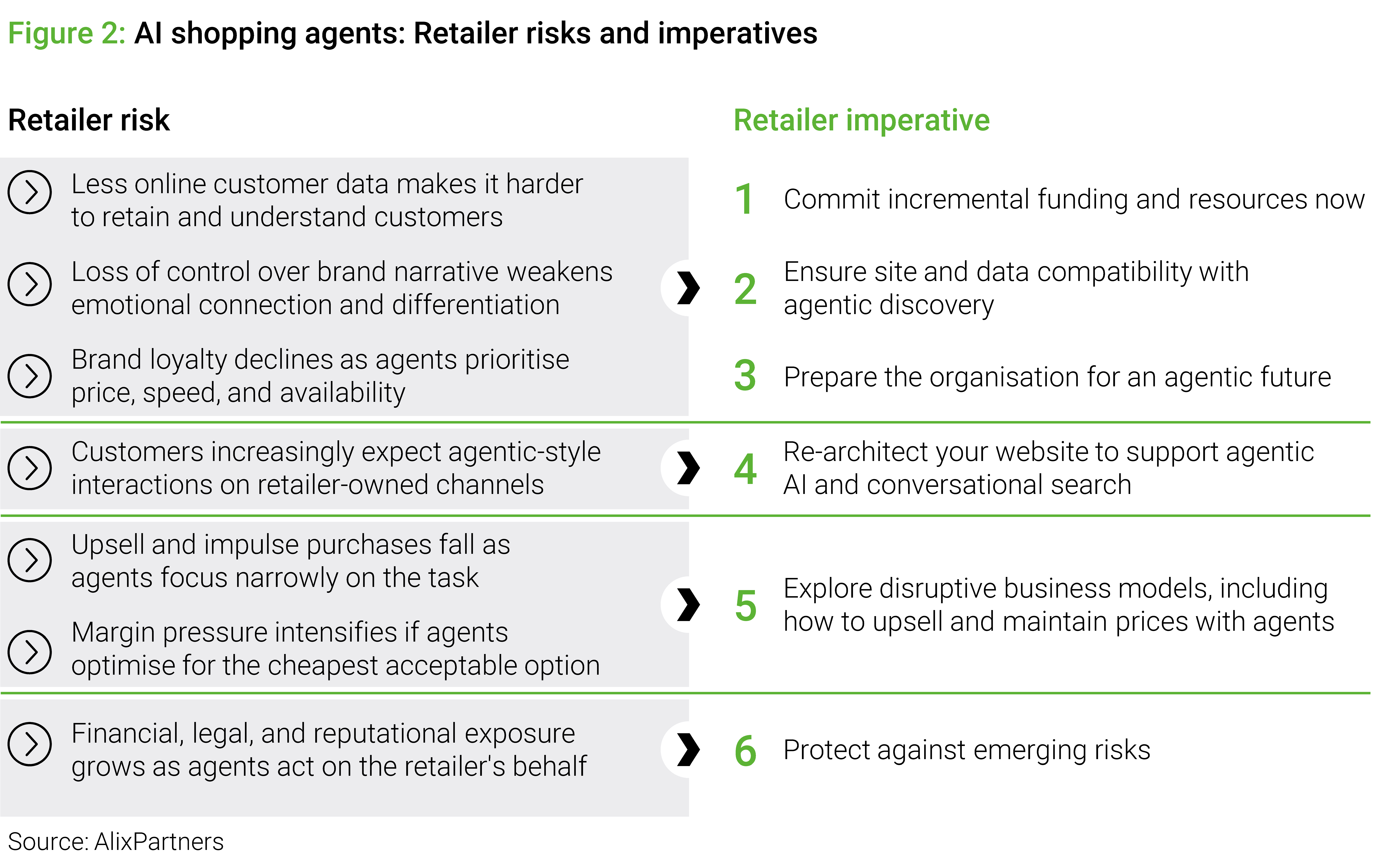
There are clear gains here for customers and for retailers, too. Shopping journeys become easier, faster, and less painful. But retailers also have more to worry about: less online customer data, weaker brand loyalty, reduced control over how the brand is presented, and fewer opportunities to drive upsell or impulse purchases.
The underlying issue is simple: agents do not shop like humans. They do not browse, respond to storytelling, or make impulse purchases in the same way. At least today, they are more likely to focus on explicit task completion, comparing options on price, speed, availability, and fit to need.
But those are unlikely to be the only signals that matter. As shopping agents mature, they may also weigh reputational signals such as review depth, customer advocacy, fulfilment reliability, and service quality. The data environment feeding LLMs is uneven, which may favour retailers with richer review histories and stronger visible trust signals, not just those offering the lowest price or fastest delivery.
Several risks arise that map directly to and reinforce the six imperatives we outlined in our first article.
Where retailers play determines the urgency and nature of their response
Not all retailers face the same level of exposure.
Retailers selling branded or specialist products are generally better positioned to weather the agentic shift. A differentiated proposition gives customers a reason to maintain a direct relationship, even as AI agents take on more of the discovery and transaction journey, provided the AI agents recognise the distinct value of those brands. Customers may still value expert curation, emotional resonance, brand trust, and unique product ranges. Stronger loyalty also gives these retailers more room to adapt their platforms for agentic compatibility without immediately surrendering the customer connection.
Commodity retailers face a far greater threat. When price, speed, and availability dominate the decision, customers are more likely to be indifferent between one retailer and another. Without deliberate action, these businesses risk becoming invisible fulfilment channels inside somebody else’s ecosystem and losing the customer relationship.
Between these poles sit trusted omnichannel incumbents, whose brand recognition, review depth, fulfilment reach, and service reputation may make them more resilient than a simple “commodity” label suggests.
For those retailers, the response needs to be faster and more direct. That means building agentic capabilities within their platforms before third-party agents like Amazon’s Buy for Me or OpenAI’s Operator define the customer experience on their behalf.
Acting on the six imperatives
In practical immediate terms, that means acting on the six imperatives we set out in our first article:
The weaker the underlying proposition, the more exposed a retailer is to the rise of third-party agents. That makes it more important to build retailer-side agent capabilities inside the e-commerce stack and create reasons for customers to engage directly, while still integrating effectively into the wider customer-agent ecosystem.
Do you want to be available to agents at all?
A more fundamental question sits alongside the six imperatives: do you want to be available to agents at all? Retailers face a binary choice: open the catalogue to ChatGPT, Gemini, Perplexity, and others and compete to be the agent's recommendation, or deliberately block agent access and force customers to come directly.
Amazon has chosen the latter: rather than feed third-party agents, it has built Rufus and Buy for Me and withdrawn from channels it does not control. Few retailers have Amazon's pull, but the question applies to all of them, and the answer reshapes GEO investment, API strategy, and how the brand appears in someone else's interface. We will return to this in a later article.
This remains a journey, not a sprint
Retailers should not expect to solve this overnight, and not every retailer should aim for the same North Star. But they do need to start now.
In our second article in this series, Winning the digital shelf: Preparing for a world of human and AI shoppers, we outlined a practical Crawl-Walk-Run maturity curve for building capability over time. The goal is not to leap straight to an end-state, but to set the right strategy, build the right foundations, and progress in sequence.
Winning in this new environment will require a series of practical steps as discovery, comparison, and transaction become more AI-mediated. The market is moving quickly. Retailers that start building now will be in a far stronger position than those that wait for the model to fully settle.