James Cass
Partner & Managing Director - London

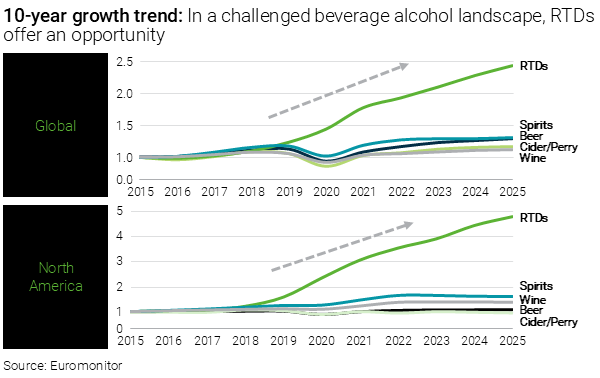
In a challenged beverage alcohol landscape, one category continues to outperform: ready-to-drink (RTD). Over the past decade, RTDs have outpaced every other segment globally, and in North America, the gap is nearly 2x.
The drivers go beyond a growth chart. Consumers are no longer simply beer drinkers or wine drinkers. Consumers switch by occasion, and RTDs sit at the intersection of health and wellness, premiumization, and convenience. At the same time, competitive lines are blurring as global brewers, spirits majors, and agile challenger brands all compete for the same shelf space and consumer moment.
The consumer profile
The modern repertoire drinker: consumers who no longer identify with a single category (e.g., beer drinker) but switch fluidly between beer, seltzer, and cocktails based on occasion
The competitive convergence
Competitive lines are blurring. Global brewers are expanding beyond beer (e.g., Molson Coors, AB InBev) vs. split majors entering the convenience channel (e.g., Diageo, Suntory) vs. agile disruptors (e.g., High Noon, Surfside)
Macro trends
Key external factors such as the health & wellness halo, tax class implications (sugar brew vs. spirits), and the premiumization tailwinds driving value over volume
Consequently, RTDs have massively outperformed other beverage alcohol categories over the past decade. While the pattern is similar globally, the magnitude of RTD performance relative the rest of the category is nearly 2x in North America.
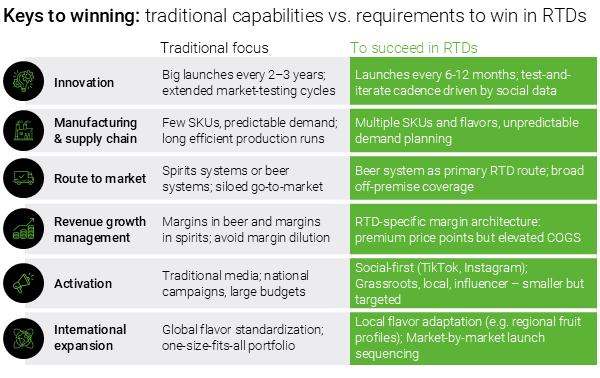
Winning in RTDs requires a fundamentally different operating model. Innovation cycles compress to 6- to 12-month test-and-iterate cadences. Activation shifts from national TV budgets to social-first, influencer-led marketing. And margin architecture must be rebuilt from scratch around premium price points and elevated COGS. The playbook that built the great beer and spirits brands of the last century is a starting point, not a blueprint.
For traditional players, success in the category requires the evolution and tailoring of core capabilities to RTDs.
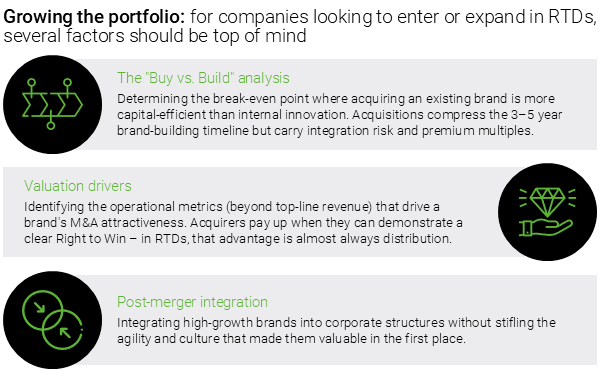
For companies looking to enter or expand, three questions dominate the growth agenda:
Buy, build, or hybrid?
What metrics actually signal durable M&A value versus momentum?
And how do you integrate a high-velocity brand without killing the agility that made it valuable?
The answers in RTDs almost always come back to distribution. Acquirers with national beer-system coverage hold a structural advantage that takes competitors years to replicate. The number one integration failure mode: forcing RTD timelines into quarterly CPG planning cycles.
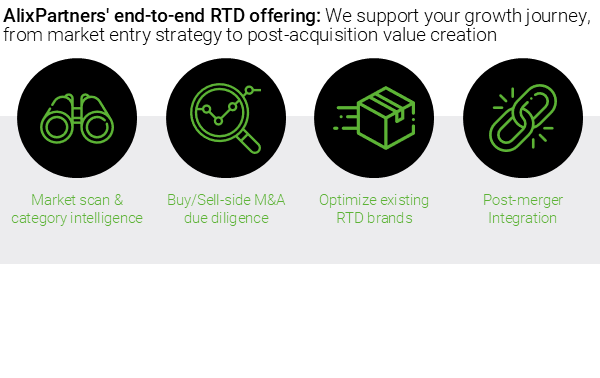
AlixPartners brings end-to-end RTD capabilities, from white-space identification and market entry strategy through buy-side due diligence, brand optimization, and post-merger integration. We have advised global brewers, spirits majors, and agile challenger brands navigating this category.
If you are evaluating your RTD strategy, we would welcome the conversation.