
John Dischner
Partner & Managing Director - Chicago


Boards depend on timely, complete information. CFOs who provide their boards with a comprehensive picture with sufficient time to act on it earn both trust and strategic latitude. Directors defer more, push back less, and treat the CFO as a thought partner rather than a reporter. When the CFO can deliver that picture consistently, at high resolution, and on demand, the company wins.
While AI technologies can empower CFOs to provide that total picture in ways never before possible, they haven’t changed what boards need. What AI does change is how effectively CFOs can provide that picture, at what resolution, and how quickly.
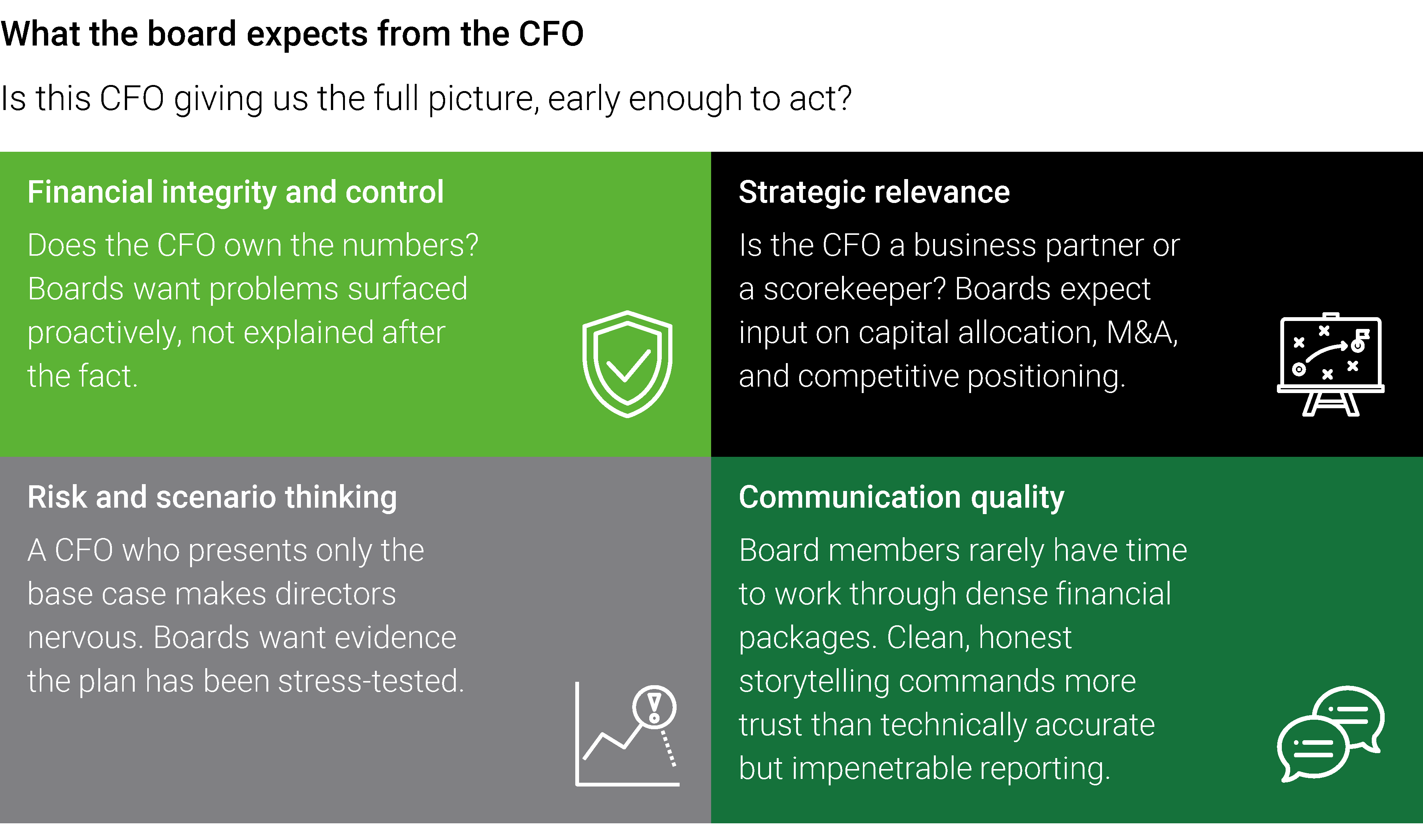
Boards hold several essential expectations of their CFOs, including: 1) financial integrity and control, 2) strategic relevance, 3) scenario thinking and risk mitigation, and 4) communication quality. Regarding integrity, directors need CFOs to own the numbers transparently and provide sufficient lead time to avoid rushed decisions. On strategy, boards want more than a scorekeeper; they expect meaningful contributions to capital allocation, M&A, expense management, and competitive benchmarking. When it comes to risk, presenting only the base case is a missed opportunity; trust is built through a demonstrated pattern of thinking beyond it. As for communication, boards are pressed for time and need a clean, honest story. The CFO who conveys the picture clearly commands far more credibility than one who is technically correct but hard to follow.
In reality, most companies can’t yet deploy AI-powered scenario planning because their financial infrastructure wasn’t designed for it.
Legacy systems, including siloed ERP modules, static Excel models, and manual data pulls create a challenging combination: fragmented data that takes weeks to integrate, models disconnected from live operational systems, and finance teams trained to work in monthly or quarterly cycles rather than continuous updates. To unlock AI’s potential, CFOs need three foundational pieces in place:
The CFOs winning here aren’t waiting for perfect data or complete solutions. They’re building iteratively, starting with one workstream (e.g., cash flow forecasting, covenant tracking, working capital), proving the value, and expanding.
What can it look like when CFOs unlock the power of AI to help them with their governance interactions? Five areas show compelling potential:
The pace at which AI-powered analytics platforms can consolidate and analyze financial data profoundly changes what CFOs can deliver to boards. Instead of preparing quarterly reports based on closed books, CFOs can provide rolling analysis with real-time dashboards that boards access as needed.
Machine learning algorithms automatically identify variance patterns, flag anomalies, and generate preliminary explanations for performance deviations. What previously required hours or days of manual investigation by financial analysts can be surfaced in a fraction of the time. This allows the CFO to dedicate more time to interpretation and strategic implications rather than mechanical data assembly.
Directors receive more comprehensive financial narratives, enabling deeper analysis of segment performance, customer cohort economics, and operational drivers. The CFO’s credibility is strengthened by demonstrating command of detail across multiple dimensions.
AI is helping CFOs run scenario analyses in fundamentally new ways that are not only faster, but also more comprehensive. Rather than manually building and testing a handful of pre-set scenarios, AI integrates directly into financial modeling platforms and spreadsheets, automating the variable inputs, running hundreds of permutations in minutes, and updating results as new data arrives.
Specifically, AI can:
AI models trained on historical patterns can forecast cash flows, identify working capital stress points, model revenue scenarios under different economic conditions, and simulate the financial impact of strategic initiatives. These capabilities elevate board discussions from post-mortems to strategic planning conversations.
Furthermore, a board considering a major acquisition can instantly understand financial implications across dozens of scenarios, with the CFO positioned as the analytical guide.
AI shifts the CFO’s role from a mechanic who builds scenarios to a strategist who interprets them and makes informed judgments.
Much of a CFO’s relationship with the board comes down to identifying, communicating, and mitigating risk. AI-enabled monitoring of transactions and operational variances enables CFOs to spot problems and escalate them before they become board-level surprises. This frees the CFO from the traditional dependence on analysts to notice something in a monthly review.
AI can help CFOs monitor transactions and flag risks related to fraud, cyber threats, or regulatory exposure before they reach a critical state. With AI-powered early warning systems, CFOs get better information. They move from quarterly reporting to real-time dashboards that highlight performance, liquidity, and runway, ensuring the board is never surprised by a sudden dip in revenues.
Traditional risk management has relied upon CFOs identifying and stress-testing a handful of known risks, such as covenant breaches, customer concentration, and FX exposure. AI can uncover hidden risks that manual analysis tends to miss: unexpected correlations (such as when demand and commodity costs spike together), second-order effects (how a supply chain disruption cascades through working capital), and tail scenarios most companies never model.
AI can help CFOs transform scenario analysis from a planning ritual into an active governance shield by shortening the window between risk detection and response. The technology can run hundreds of permutations across macro variables, competitive dynamics, and operational stress points to expose concentration risk, uncover dangerous assumptions, and identify where the business is truly exposed. More importantly, it can do this continuously, so when market conditions shift, the CFO sees the risk surface in real time rather than months later in a periodic variance report.
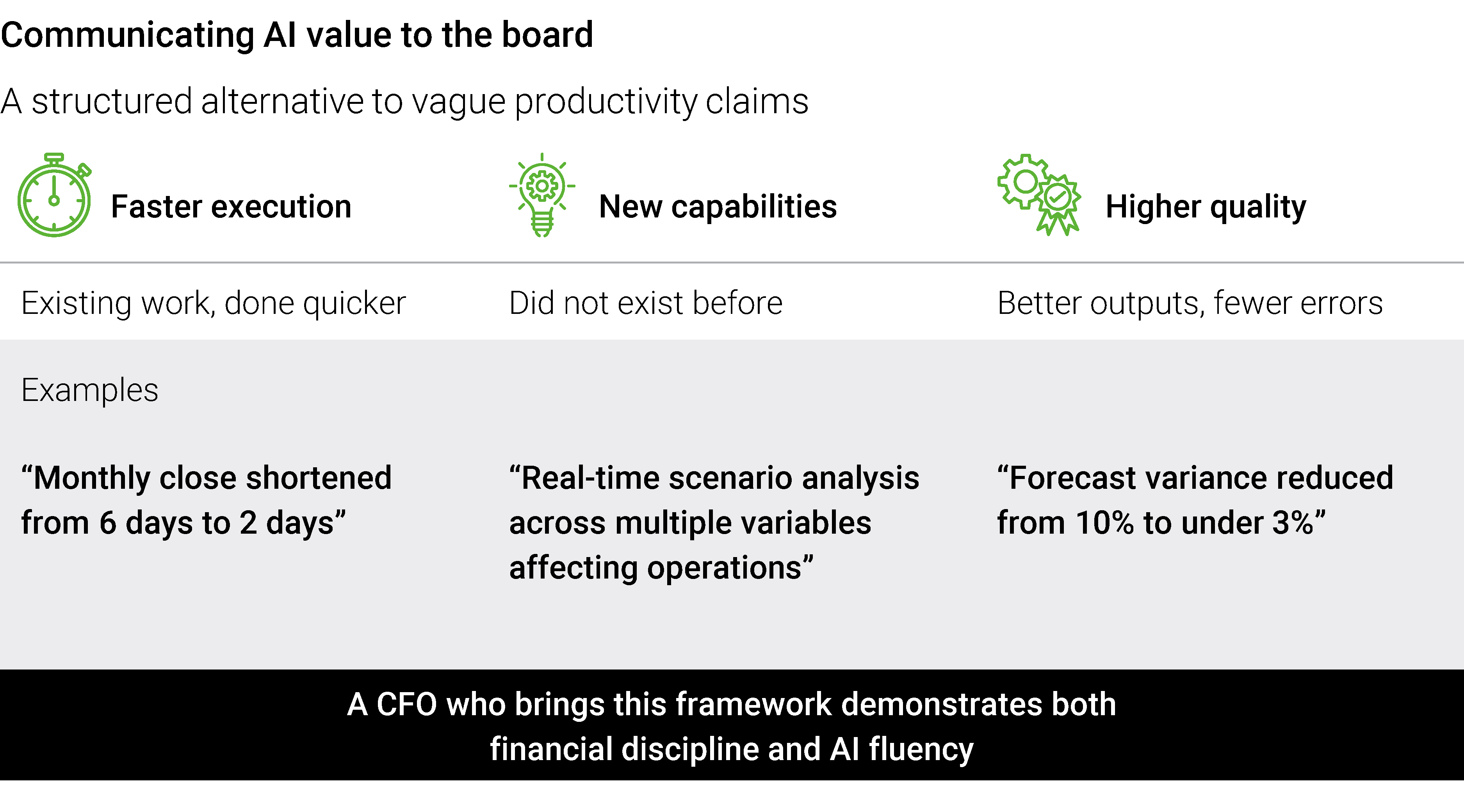
AI represents one of the most substantial capex and spend areas for many companies, and boards are increasingly dependent upon CFOs to validate the investment. This requires discerning credible and measurable gains from optimistic vendor promises. Measuring ROI depends on meaningful KPIs for AI value, which might center on metrics such as the percentage reduction in forecast variance or the time saved in the monthly close.
Though it may seem circular, the reality is that AI tools themselves can help model the true cost and benefit of AI deployments across the enterprise. They can help CFOs translate technology investment into terms the board can evaluate. Additionally, they can provide CFOs with essential information as they assist boards in establishing guardrails around AI use, ensuring data integrity and ethical compliance are part of the corporate strategy.
There’s potential for CFOs to leverage AI to have a much clearer picture of their portfolio’s value sources (segments driving the most profits), value drivers (market and competitive forces driving profits in each segment), and value implications (optimal resource allocation and most relevant scenario analysis).
This level of clarity depends upon detailed analysis of granular financial, market, and competitive data—a process that used to require large Excel models with detailed analysis of internal financials, scraping for publicly available market and competitive data, conducting market interviews, and more. CFOs can now leverage AI to quickly gather and synthesize data on profit concentrations, as well as market and competitive drivers.
Because of the high resolution it provides, AI can help CFOs spend more time on implications and decisions that matter, such as resource allocation and M&A. It also enables scenario-based modeling to answer “what if” questions, such as:
Delivering these capabilities is only half the job; conveying their value to the board is the other half. By using a framework that distinguishes among three areas of value, CFOs can demonstrate both financial discipline and AI fluency in their communications with directors. This ROI-scorecard approach abandons jargon around productivity and instead doubles down on three specific value-adds: speed of execution, novel capabilities, and boosted quality.
The CFO can be a reporter. The CFO can be a scorekeeper. But ideally, the CFO can be much more than that—a genuine partner in the essential work of governance. Getting from the former to the latter means getting off the treadmill of mechanical reporting and stepping into the role of accurate storyteller. Boards want to know not just what’s happening with the numbers, but why. They want to be surrounded by deep insights, not drown in a deep sea of details (even if they’re accurate). They need and want to know what matters in order to make the most informed decisions possible.
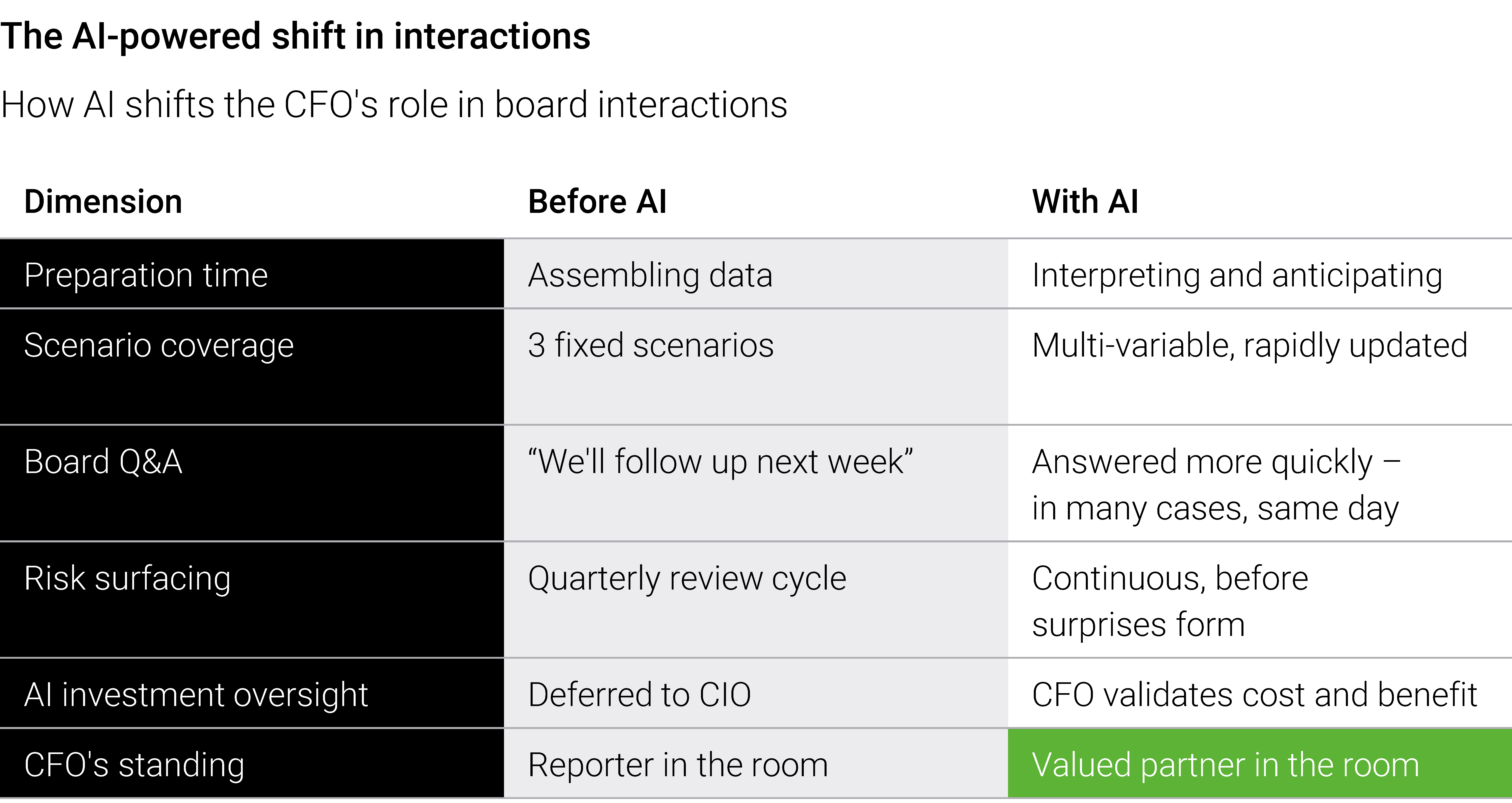
AI technologies offer CFOs a range of tools that can make them better strategic partners with their CEOs and boards alike. It isn’t just a matter of streamlining processes or improving information at home. This shift can help CFOs adapt to changing market conditions, gain forward-looking agility, and position their companies for advantage.
The key is translating these concepts and use cases into actionable workstreams for CFOs. AlixPartners has a proven track record in performance improvement and implementation, and we partner with companies to put that track record to work.