
James Roe
Director - Chicago


The trucking sector is the workhorse of the U.S. transportation network. Nearly three-quarters of all goods Americans buy are moved by truck, and there is no substitute for getting goods on shelves and keeping regional warehouses stocked. If the economics of this system are out of balance, the impact will be felt across most industries' supply chains.
Having made it through the Great Freight Recession, the industry’s worst downturn in decades (2022-2024), rates are climbing sharply, not driven by booming demand, but because freight capacity has contracted due to carriers exiting the market, fleet downsizing, and slowing equipment investments. Shippers who treat this as a cyclical event by waiting for a return to lower rates are likely to be caught flat-footed.
The roots of the structural issues facing the trucking industry can be traced back to the massive spike in consumer demand that resulted from the pandemic era. To keep goods moving, the industry added capacity at nearly five times its historical growth rate. Once spending returned to normal levels, there were far too many trucks for the ebbing demand, causing rates to plummet, ushering in the Great Freight Recession. About 88,000 trucking companies shut down in 2023 after their operating authority was revoked or voluntarily surrendered, followed by roughly 10,000 more carriers on a net basis in the first half of 2024. By mid-2024, rates had hit roughly $1.65/mile, well below the survival threshold for many carriers, ushering in bankruptcies for firms both big and small.
Despite a reduction in capacity that led rates to a slight rebound above the $2/mile mark in late 2024 and 2025, rates continued to bounce around in line with seasonal demand and tariff-induced inventory front-loading as the new industry dynamic took hold: trucking capacity shortages were not temporary, and would not be quickly turned around.
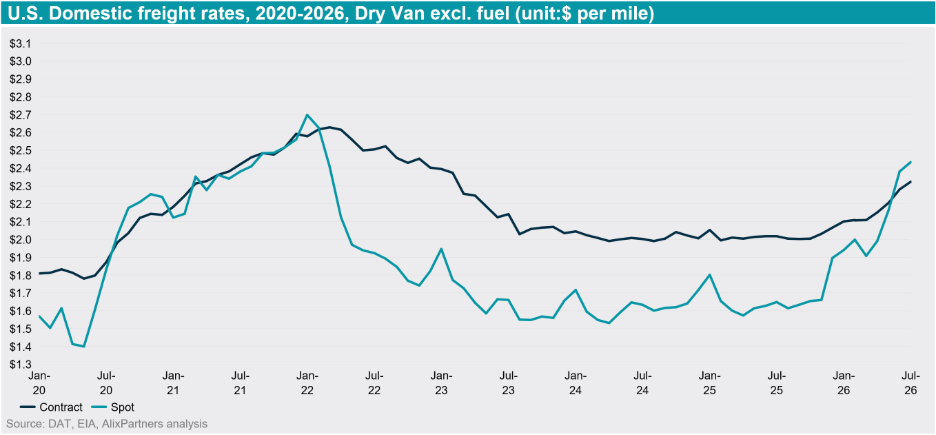
Traditional cycles of the past that assume rising rates indicate strong demand are not applicable in today’s market, where the primary issue is actually fewer drivers and trucks resulting from new regulations, higher costs, and carrier consolidation.
Driver shortages resulted from new federal eligibility rules that have forced between 250,000 and 400,000 drivers out of the market. A March 2026 federal rule barred asylum seekers, refugees, and DACA recipients from holding commercial driver’s licenses, impacting nearly 1 in 6 U.S. truckers and disproportionately impacting small fleet owners with ten or fewer trucks. Other issues impacting the driver supply side include the English language requirement and wage inflation outpacing wage growth. A 2026 estimate puts the industry at a shortage of 82,000 drivers, which is expected to nearly double by 2031. To replace retirements and meet freight growth needs, the industry will need 1.2 million new drivers.
Additionally, maintenance costs are rising for an aging truck fleet, 69% of which are operating beyond their ideal replacement age. On top of higher maintenance burdens, Class 8 trucks incur $8,000 to $25,000 in additional costs for required emissions technology. Smaller carriers, who make up 92% of the industry and cannot absorb these costs, are exiting.
Large fleet operators are not immune to these challenges. Since January 2024, over 8,000 trucking companies have exited the industry. Leading LTL carrier, Yellow Corporation, with over 30,000 trucks in its fleet, was forced into liquidation, and thousands of smaller carriers followed. Although net revocations had slowed by May 2026, new capacity has not followed.
Current demand signals are complicated: overall freight volumes are down year-over-year across all major trucking categories, tariff-inspired inventory front-loading has ended, yet retailers are cautiously restocking above recent lean inventory levels, even as consumer demand remains uncertain due to overall macroeconomic conditions. Despite a bright spot in flatbed and industrial freight serving data center construction, overall tonnage capacity remains choppy month to month.
Amid the uncertainty, spot market rates, which have risen above contract rates for the first time since early 2022, may be the clearest indicator of the industry’s structural shift from oversupply to undersupply.
The rate outlook for the next 12-18 months is what matters now for shippers focused on 2027 budgets and contract negotiations, and it isn’t likely to drop any time soon. The capacity that is missing from the market will take years to rebuild. This structural imbalance means shippers can expect 4Q2026 rates to remain 15-20% over those one year ago.
Analysis of earnings guidance from major carriers, including J.B. Hunt and Schneider National, indicates they are raising it, signalling that they expect rates to hold. Increasing carrier confidence, combined with the spot market inversion data, is a strong indicator that shippers should heed.
Shippers looking for the most favorable terms when the odds favor the carriers should consider four action areas:
Shippers looking for a return to 2023 lows are likely to be disappointed. Adding up the structural shocks of driver attrition, regulatory pressure, and a reduction in carriers results in a deficit that will take time to recover from. A murky demand picture adds to the uncertainty. Shippers who adapt their contracting, carrier relationships, and mode strategies now will be better positioned for the next 12–18 months.