
Jerry Wang
Partner & Managing Director - New York


Behavioral health executives are familiar with the operational challenges highlighted by their peers in the 2026 AlixPartners U.S. Healthcare & Life Sciences Survey. Reimbursement pressure, regulatory complexity, and workforce shortages are pervasive.
These dynamics are likely to persist well beyond the Medicaid provisions in the One Big Beautiful Bill that take effect in January 2027, including community engagement and work requirements, increased redetermination frequency, and shortened retroactive coverage.
There are potential upsides when adapting to the disruption rippling through the sector. Behavioral health outpatient demand is forecast to continue outpacing available supply for the next decade. The rewards will flow to operators who have built lean, efficient models rather than those focused purely on top-line expansion. AlixPartners’ executive survey maps four key findings onto the operational and financial realities that behavioral health is navigating.
1. Reimbursement erosion
Declining reimbursement is one of the biggest drivers of distress across healthcare, with more than 70% of survey respondents citing public payers as their largest source of reimbursement pressure. Behavioral health is the hardest hit, with reimbursement rates running less than 80% of those for comparable medical and surgical services, according to a government study.
Payors are increasingly scrutinizing the length of inpatient and residential stays. The shift to partial hospitalization programs, intensive outpatient protocols, and telemedicine moves care into settings facing more local competition and thinner margins.
Even small changes in payer dynamics can have outsized impacts on profitability. It’s a dynamic that’s especially acute where thin per-visit margins mean a delayed authorization or rate reduction can quickly undo an otherwise viable model.
2. Regulatory and policy uncertainty
The muddied landscape ahead was cited as the primary driver of distress by 44% of healthcare respondents in our survey. For behavioral health platforms, the uncertainty compounds quickly as disparate licensing frameworks, Medicaid program rules, and managed care contract requirements vary from state to state.
There has also been a wave of state-level behavioral health redesigns and evolving licensing standards for Opioid Treatment Programs and outpatient substance use services. Less than half of survey respondents said they felt adequately prepared for the changes.
States are shaping coverage requirements on their own as federal enforcement of the Mental Health Parity and Addiction Equity Act becomes increasingly contested. That’s creating a range of mental health parity laws governing payor utilization management rules. Proposed federal Medicaid reductions could also increase the financial strain on hospital-based psychiatric services, many of which already operate at a loss.
There are instances of policy moving in a provider-favorable direction, such as CMS's proposed 2026 physician fee schedule. This adds new billing codes for integrated behavioral health services and expands reimbursement for digital mental health options. However, the net effect for most operators is a patchwork of rules that shift from year to year and state to state.
3. A structural workforce crisis
The biggest driver of distress in the survey is labor, cited by 51% of respondents. In behavioral health, this includes persistent shortages of psychiatrists, psychiatric nurse practitioners, licensed counselors, and social workers, compounded by high turnover driven by the emotional demands of the work.
Peer support specialists and care managers are essential to good outcomes, but are often only partially reimbursable. This creates a structural gap between what the care model requires and what the payment system funds. Margins will stay constrained without changes to the workforce model or reimbursement policies.
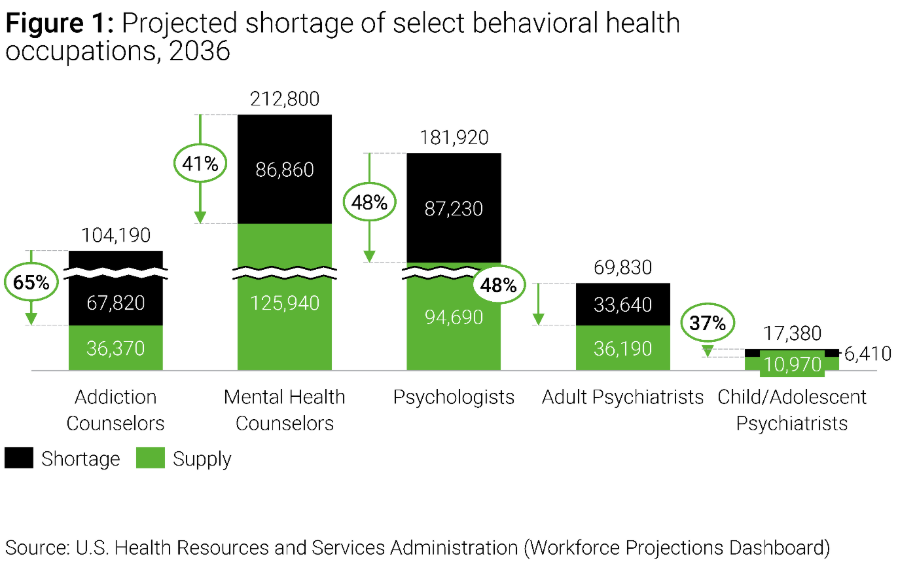
Federal data bear out the pressures, with projected FTE shortages by 2036 of more than 87,000 addiction counselors, 70,000 mental health counselors, over 62,000 psychologists, and more than 42,000 psychiatrists. This is not a temporary staffing dislocation that will resolve on its own. It’s a structural supply gap that will put pressure on wages and drive turnover higher.
4. Revenue cycle management is a survival imperative
Half of the healthcare operators surveyed plan to significantly increase investment in revenue cycle management over the next year. RCM performance is a direct driver of financial sustainability amid tighter payer controls, more frequent denials, and stricter documentation requirements.
The complexity of behavioral health only amplifies that urgency, with multi-discipline billing across medication management, individual and group therapy, intensive outpatient programs, peer support, and case management. Benefit definitions also vary widely by payer. Credentialing and enrollment requirements for licensed and provisionally licensed clinicians can lead to denial rates running higher than in medical and surgical care.
Providers that don't treat RCM as a strategic priority risk leaving meaningful revenue on the table, even as patient volumes grow.
Building durability
New and scaling behavioral health operators have real work ahead. Those who pull the right levers now will be positioned to seize new opportunities. Key practices include:
Focus on profitable growth and minimum performance levels across the business, down to the clinic/unit level. Ask hard questions about where future expansion should occur, how to correct the existing footprint, and how the care model needs to work at today's reimbursement levels
Shift from revenue growth to an EBITDA-expansion mindset. Rapid consolidation to build scale and topline growth has created operating models and mindsets that sacrifice margin in pursuit of growth. Turning this around requires actively managing cost structure and top-line performance together, across the organization, rather than preserving outmoded stovepipes.
Close the RCM gap early. Even modest improvements in a constrained-rate environment can help recover revenue that would otherwise be lost. In the new payor environment, this requires close collaboration among providers, utilization review teams, and revenue cycle experts to ensure both appropriate clinical care and proper reimbursement.
Behavioral health remains an attractive specialty for investors. Relatively recession-resistant demand, the increased needs of an aging population, a fragmented market ripe for consolidation, and stable cash flows that support leverage are standout features.
The strategy of buying fragmented assets, consolidating, centralizing administrative functions, and expanding margins still works. Unlocking the potential requires platforms that have already solved reimbursement pressures, regulatory complexity, and workforce constraints at the unit level. Rolling up inefficient assets without fixing the underlying operating model simply scales the problem.
Operators and investors who treat today's constrained environment as a forcing function, not an excuse, will be the ones best positioned to capture the upside.