

James Roe
Director - Chicago


Ocean freight costs are behaving unusually. Two of the world’s largest trade lanes – Transpacific and Asia-Europe – are moving in opposite directions for the first time in over two years. In 2024, the Red Sea crisis acted as a single shock, driving both lanes up and then down together in a unified cycle. Today’s divergence signals that separate forces drive the two trades. What are the dynamics behind this current cycle, and how does it affect your near-term supply chain decisions?
The normal autumnal post-peak correction has not arrived on the Transpacific route. At this time of year in 2025, U.S. container demand was trending down, with further softening expected after the Golden Week pause in commercial activity. Instead, China-U.S. rates are still climbing as of mid-September. Shanghai-New York topped $10,394/40ft, exceeding $10,000 for the first time since 2022.
At the same time, Asia-Europe is falling, with Shanghai-Genoa down 5% to $4,016 and Shanghai-Rotterdam down 9% to $3,626. The two trades have now diverged for seven consecutive weeks.
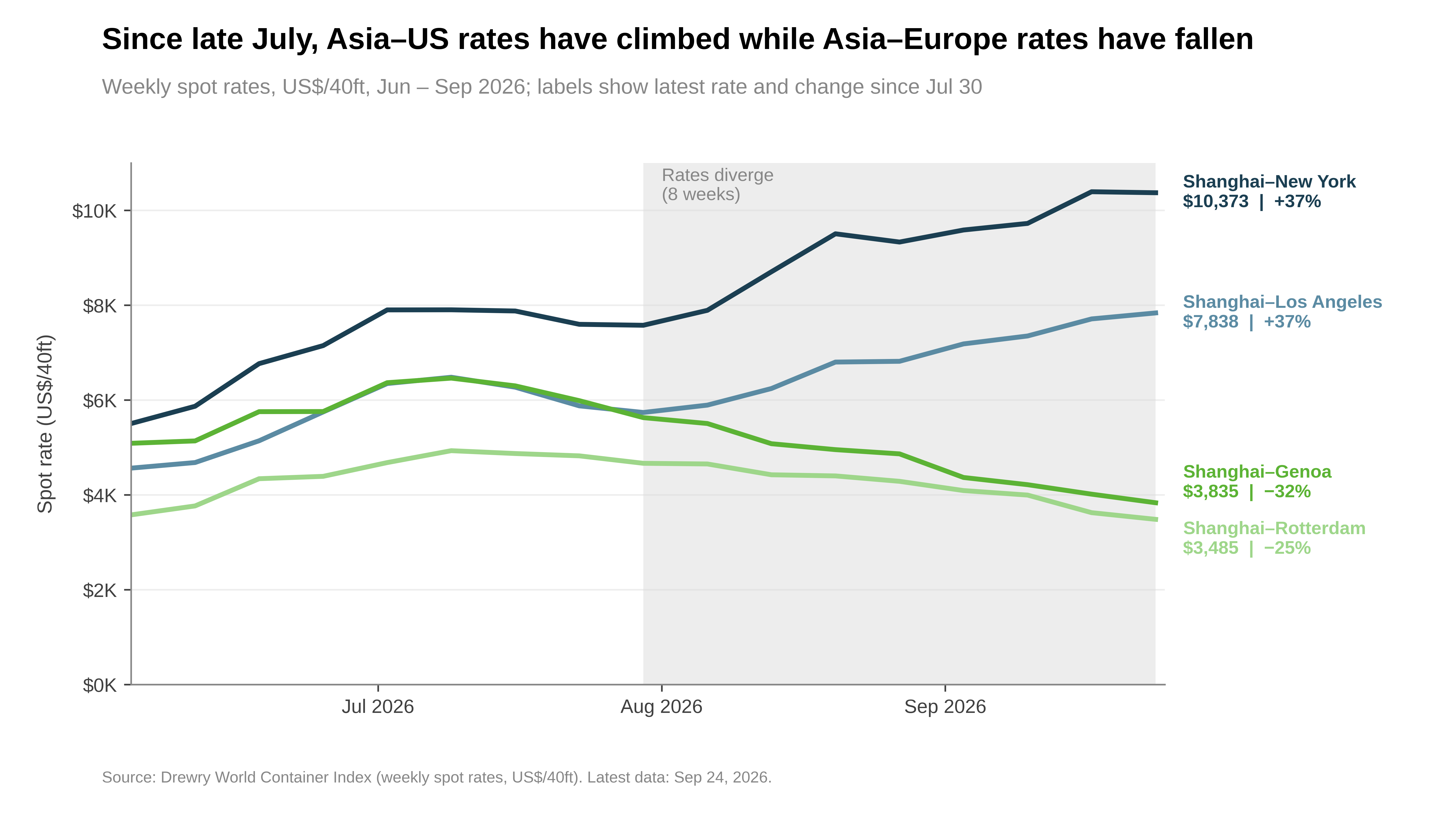
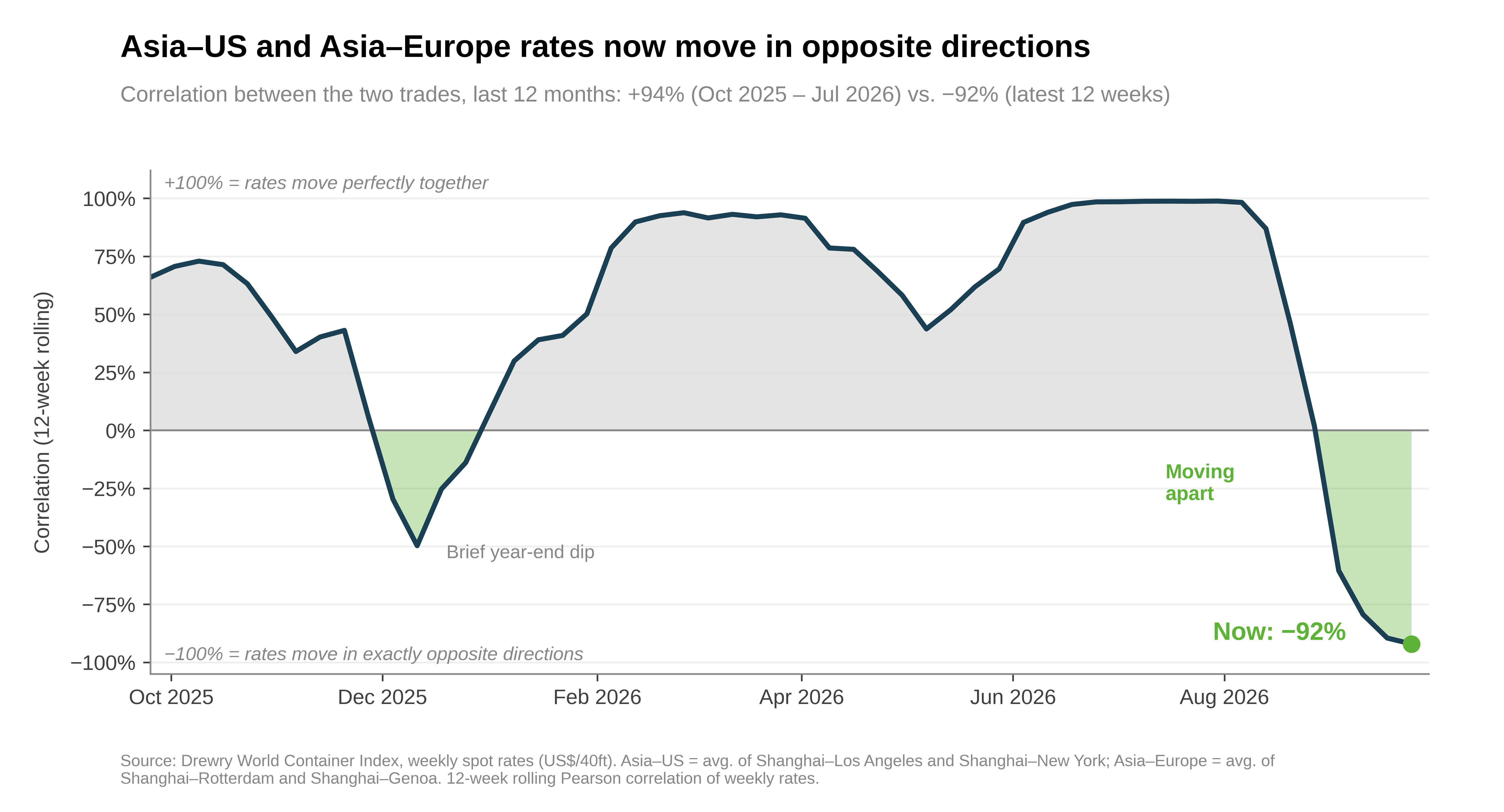
While U.S. demand is resilient, if not exceptionally strong, the current surge in rates can be attributed to the compressed pre-holiday window and reduced effective capacity.
August U.S. imports of 2.60M TEU, the third-highest month on record (3.3% year-on-year growth), and China-origin imports of 884K TEU (1.7% year-on-year growth) indicate that tariff frontloading shifted shipment timing but did not eliminate peak-season demand. A shortened window, with only three days between the Mid-Autumn Festival and Golden Week, prompted manufacturers and shippers to accelerate production and bookings before the holiday shutdowns. Timing pressures were further amplified by typhoons that pushed berth waits to roughly 10-12 days at Shanghai and Ningbo, creating cargo backlogs for shippers rushing goods to market before the holidays and concentrating demand into fewer available sailings. Finally, carriers' deliberate concentration of blank sailings on the Transpacific route while pulling capacity from Europe is another major driver of the rate surge.
As major ocean alliances focus blank sailings on the Transpacific route to maintain high rates, European rates are falling due to geopolitical shifts. The return of the Suez Canal to service is releasing capacity into the Asia-Europe trade, pushing rates down. Suez has seen a 51% increase in net cargo year-on-year. By mid-September, an estimated 27% of total Asia-Europe capacity was routing through Suez again, up from near zero a year ago. Zencargo estimates that a full return could release roughly 6% of global fleet capacity into an already oversupplied market, leading to further downward pressure on rates.
While the immediate impact of increased traffic in the Suez Canal is on Asia-Europe trade, additional geopolitical factors continue to shape the global ocean freight story.
Traffic through the Panama Canal, a gateway for Asia-U.S. East Coast routes, is facing reduced transits due to current water levels and expected drought conditions from this year’s El Niño. The Panama Canal Authority (PCA) reduced daily transits from 36 to 34 on September 4, and then to 32 on September 15. These cuts are reflected in increased transit slot auction prices, with August daily auction average fees over $1.1M per day, up from an average below $300K the previous year. As a result of these restrictions, major carriers have imposed surcharges of $150-$500 per TEU.
A trade route established by China’s Sea Legend saw the first container ship transit from China to England via the Arctic Circle this summer in 20 days rather than the typical 30-day trip via the Indian Ocean and Suez Canal. While 8 ships from a single carrier are not enough to impact the global market, future expansion of activity in this route is worth monitoring.
While traffic in the Strait of Hormuz does not directly impact shipping rates, the indirect impact comes from high fuel prices driven by the ongoing conflict with Iran.
Elevated rates will likely begin to moderate seasonally, although carrier decisions and external disruptions will influence the magnitude and timing. This could translate into several distinct phases rather than a traditional post-peak rate decline as geopolitical tensions and fuel costs create a higher floor under rates.
Given the market volatility, shippers should focus on building flexibility and resilience into their transportation strategy rather than spending time forecasting rate changes.