
Vance Scott
Global Co-Leader, Energy & Process Industries, Partner & Managing Director
Houston
Vance Scott
Partner & Managing Director - Houston


AlixPartners recently made the case that focused mining companies routinely outperform diversified peers on 10-year total shareholder returns (TSR). The findings were based on a study of 50 major publicly listed miners with market values exceeding $5 billion.
Where pure-play operators thrived, the diversified players struggled. In the study, no diversified miner achieved a top-quartile long-term TSR. While the TSR disparity is important, it is not a reason to abandon the diversified portfolio strategy. Diversification is not a codeword for value destruction. And restructuring is not a magic wand that can prop up sagging returns.
Thriving, however, requires a degree of emulation. For conglomerates to address this value gap, they must look at why pure-play operators enjoy a premium that averages a 13-15% discount on conglomerates and question whether the current strategies to bridge the valuation gap, including M&A, are sufficient.
The question is not whether diversified players need focus. The answer to that is, of course, yes. Instead, it is important to look at the various levers these companies can pull to achieve it.
Focus should not be narrowly defined as a portfolio strategy alone. While the mining industry often uses the word to describe a narrow or lean commodity mix, it should first be considered a philosophy for running a business. Our research indicates that focused operators do the following three things well:
Disciplined spending
Commodity specialization
Targeted growth strategies
Diversified operators, meanwhile, face practical challenges when it comes to addressing portfolio value. The list includes:
Removing complexity
Clarifying opaque capital allocation
Identifying and remedying hidden underperformance
The road to better returns starts with understanding roadblocks, but also identifying the advantages diversified miners bring to the table. These companies have pooled funding capacity, sustained investment through cycles, and coordinated major commitments to governments and communities.
Investor appetite is not a constraint. Global mining M&A reached US$93.7 billion in 2025, a 13-year high, as capital chases exposure to critical minerals. Interestingly, the increase in capital has clustered around miners that have proven operational delivery and the ability to accelerate brownfield development, creating a clear, evidenced business case for the investment.
However, it is important to understand the influence pure-play premiums play in shaping the economics of deal-making across the industry. When focused companies trade at higher multiples, a diversified buyer must pay that premium to acquire a target. Then, once the target is absorbed, the market may value it at the buyer's own, lower multiple, so value is diluted from day one. That math makes large acquisitions of pure-play assets harder to justify and constrains the pipeline of transformational deals.
The premium also steers diversified buyers toward smaller bolt-on acquisitions that fit their existing businesses. This helps explain why spin-offs and demergers have gained ground –if the market pays more for focus, separating a business captures that premium more directly than buying one.
Transactions can change the portfolio, but they aren’t the only route to stronger performance. A different operating model could preserve group financial capacity and still make each business as focused, transparent, and accountable as a “pure-play” standalone operator.
Teck’s recent approach illustrates the pursuit of both focus and diversity. The Canadian miner completed the sale of its steelmaking coal business in 2024, with the strategic intent of refocusing on base metals and copper growth. When the deal was first announced, Teck’s Chair, Sheila Murray, said the transaction "unlocks significant value for Teck and its shareholders."
Then, about a year after closing that deal, Teck teamed with Anglo American on a proposed merger, promising a copper-led group with premium iron ore and zinc businesses. This would provide the copper-focused Teck with “broad and efficient access to capital” through a global listings footprint.
That process represents focused diversification, not a single-commodity pure-play.
Anglo’s own transformation further illustrates the point. The proposed Teck merger (still awaiting Chinese approval) reinforces its portfolio simplification strategy, which includes planned coal and nickel disposals and the separation of De Beers. Narrowing commodity exposure and combining businesses are complementary elements of the approach, rather than opposite ends of a simple diversification cycle.
The combination targets operating synergies, not just financial scale. This is a challenge for boards to consider as they weigh the pros and cons of M&A. How much focus, financial resilience, and operational benefit can a transaction preserve, and what complexity does it introduce?
AlixPartners has identified four operating models that can drive focus. They range from a full-separation model to integrated ownership:
Sequential pure-play divestiture
Minority stake demerger
Lean portfolio holding company
Integrated diversified operator
Each buys the pure-play premium at a different price in terms of balance-sheet strength, funding capacity, operational control, and execution effort.
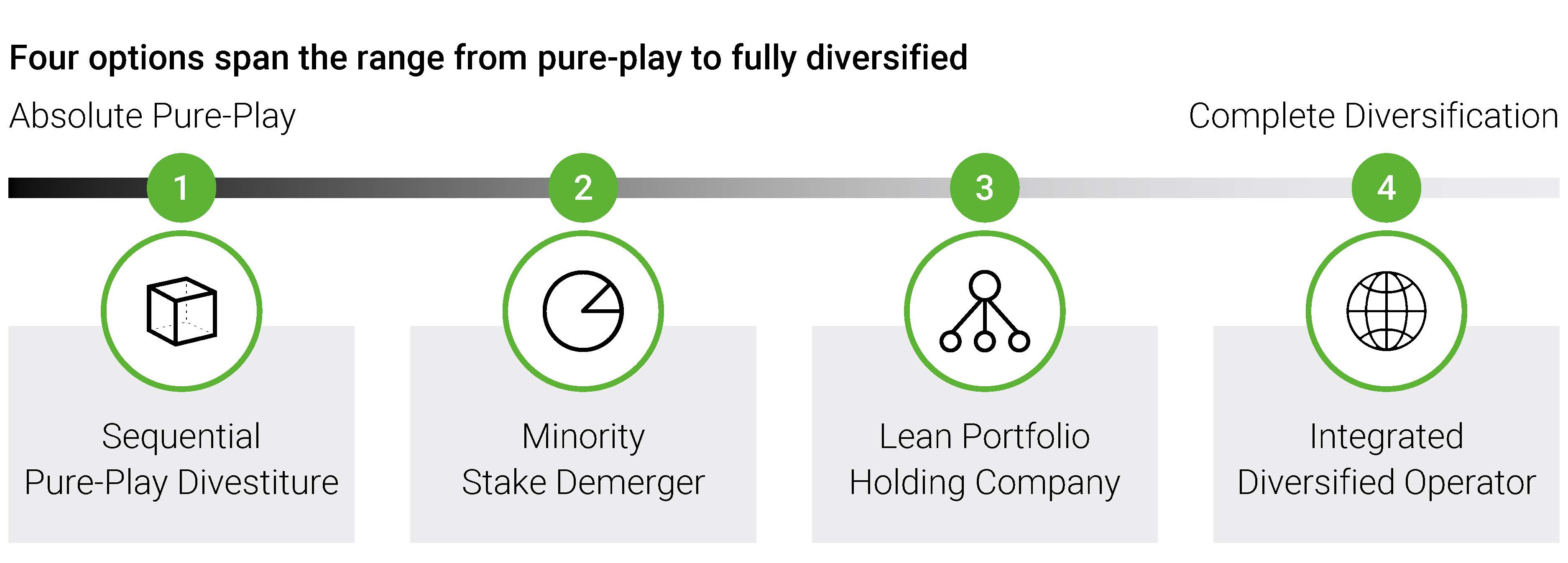
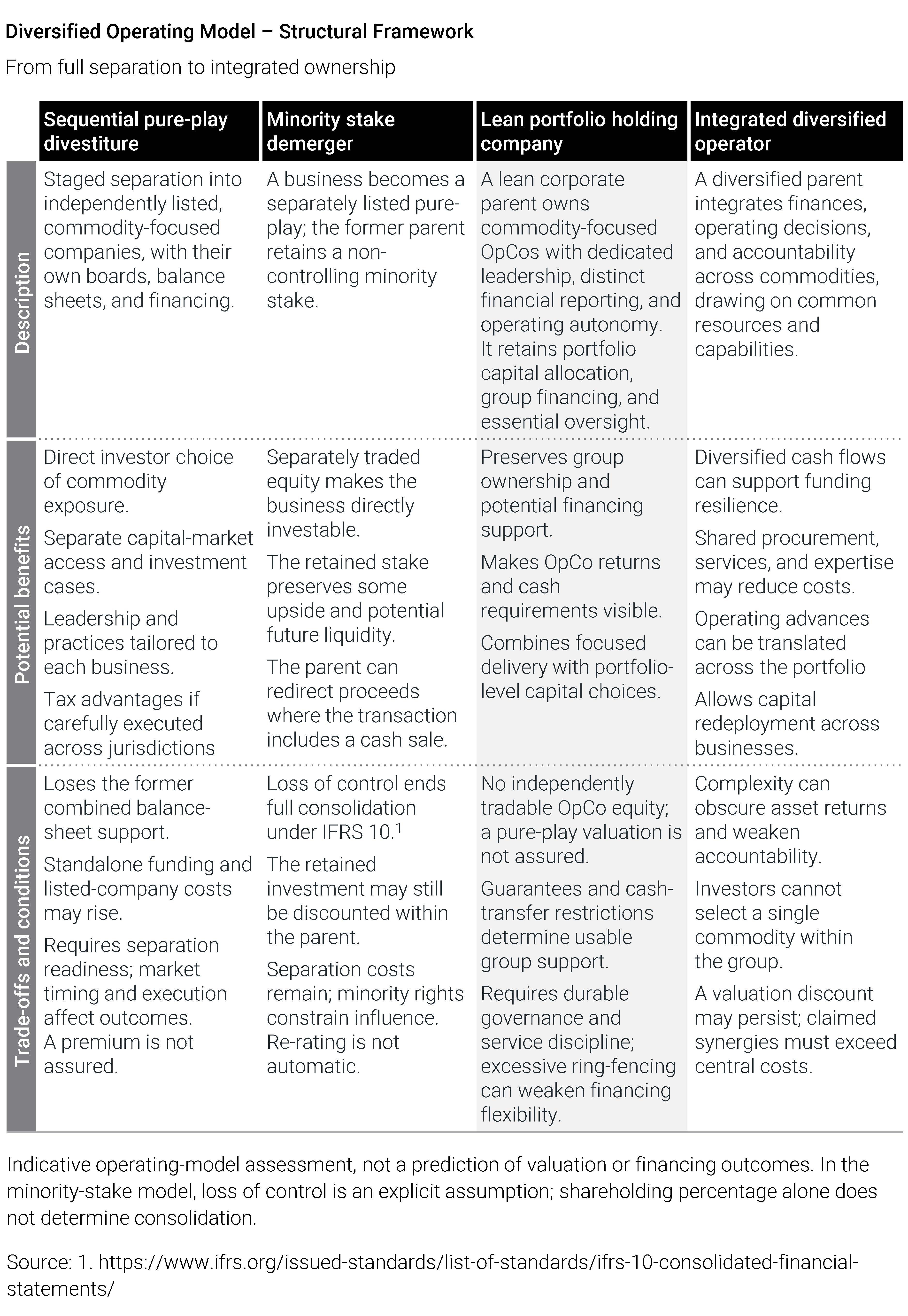
Of the four options, a lean portfolio holding company, or HoldCo, could provide the mechanism to realize the pure-play premium while maintaining a diversified-group level of access to capital.
The HoldCo is composed of OpCos, which are commodity-specific operating companies. Each has dedicated leadership, explicit economic boundaries, profit-and-loss statements and capital-employed measures, and authority over delivery.
OpCos are a pure-play asset connected to a central hub that directs portfolio strategy, capital allocation, group financing, and essential oversight across the organization. This provides the structure and portfolio that a diversified miner offers.
The HoldCo’s distinction from a conventional diversified operator is substantive, however. An OpCo must be able to explain its results without hiding behind group averages, and its leadership must control the decisions against which it is measured. The HoldCo must demonstrate why its ownership adds more value than its costs and constraints. Crafting this compelling narrative to investors is critical to realizing the benefits.
This structure can retain the funding strength of diversified cash flows while allocating capital against each business’s risks and opportunities. While consolidated accounts present a group as one economic entity, they do not make it a single legal borrower. The design must therefore test debt location, guarantees, covenants, cash-transfer restrictions, and the practical availability of support. Stronger financial ring-fencing and unrestricted access to group capital cannot simply be assumed together.
Government engagement requires the same clarity. The parent should coordinate group-level commitments and relationships, while OpCos remain accountable for local permits, community obligations, and delivery. Scale should support the credibility of commitments, not be presented as a shortcut around regulatory scrutiny.
The HoldCo model is attractive but remains untested in mining at this depth. Whether markets reward segment-level discipline without separate listings is an open question a board should test against its own investor base before committing.
The HoldCo’s appeal lies in preserving options while changing behavior, but it earns that position only if reporting boundaries, decision rights, and financial arrangements remain consistent in practice, including during a downturn.
A lean HoldCo could improve how investors value the portfolio, how capital is deployed, and how individual businesses perform, while retaining group financial capacity. Five potential benefits define the opportunity.
1. Improved enterprise value and investor perception
A clearer separation of business economics could unlock shareholder value by addressing sources of the conglomerate discount: complexity, opaque capital allocation, and cross-subsidies that conceal weak performance. Because each OpCo’s results are visible, investors can assess earnings, growth prospects, and competitive position, rather than judge the entire portfolio through a blended group narrative.
Each business would have a distinct investment case tailored to its market. Where an entity is separately listed, that becomes its own equity story. Under an unlisted-OpCo HoldCo model, it remains a transparent segment story within the group. Better visibility and demonstrably stronger returns could support a positive re-rating of valuation multiples, although disclosure alone cannot guarantee that outcome.
2. Reinforced capital disciplines and behaviors
Capital allocation would reflect the economics and future growth prospects of each business, using its own risk-appropriate weighted average cost of capital (WACC) and investment guidelines. This clarifies the return required of each OpCo, reducing the risk that access to group funding masks unattractive investments or allows one business to subsidize another without a clear economic rationale.
The HoldCo hub acts as a portfolio investor, managing capital structure and group-level options rather than negotiating competing operational priorities. Stronger return on capital employed (ROCE) and cash-return discipline could then reinforce behaviors that distinguish focused operators: investment based on economic merit, ownership of capital commitments, and attention to the cash generated from deployed capital.
3. Reduced cost and increased simplicity
A lean holding company would require essential governance and statutory responsibilities tightly aligned with the portfolio and financing functions needed to preserve group benefits. A zero-based cost structure would challenge inherited overhead rather than redistribute it. Removing the matrix and duplicated functions could eliminate unnecessary roles and reduce the process and systems complexity carried over from the integrated group.
The objective: Remove avoidable central costs, not pass them back to OpCos through blanket allocations. Necessary services would be explicit and transparently priced, with required accounting and tax charges preserved. Consolidating redundant legal entities could also reduce duplicated statutory work, subject to local obligations. Shared services would remain only where they demonstrably add value; otherwise, market-priced service models could provide a simpler, more accountable alternative.
4. Greater segment-level accountability and performance
Distinct OpCo results would connect management decisions more directly to business outcomes. Clear targets, direct consequences for performance, and rigorous portfolio reviews could lead to a stronger performance culture, with less scope for individual businesses to shelter behind group averages or attribute missed commitments to the matrix.
Segment-level visibility with leadership accountability could better prepare OpCo leaders for future HoldCo leadership. Natural competitive tension driven by proven performance to access capital across OpCo’s would strengthen leadership capabilities for the enterprise.
Dashboards and analytics provide a consistent view of results and emerging gaps. Stronger businesses receive recognition for delivery, while underperformance becomes visible early enough to prompt corrective action.
5. Accelerated agility and decision-making
Removing multiple approval layers and routine escalations could shorten decision cycles and free management to focus on delivery. Within agreed operating authority, commercial and operational decisions would sit within the business; strategy and material capital decisions would return to the center, alongside mandatory governance and risk matters.
This would place decisions closer to customers and markets, allowing each OpCo to respond more quickly to conditions in its own sector. The potential advantage is the responsiveness of a focused operator without surrendering access to group resources, with less time spent coordinating internal approvals and more spent acting on business priorities.
Leveraging the HoldCo balance sheet and resources should provide a speed advantage relative to the “pure-play” commodity players when unanticipated opportunities emerge as well. Eliminating the time, energy, and legal and administrative bureaucracy spent securing financing for fast-moving deals should be a strong advantage in the HoldCo model.
A lean HoldCo could enable the combined disciplines of focused businesses with the financial capacity of a diversified group. Its potential value lies in a clear investor value proposition, stronger capital disciplines, lower cost, sharper accountability, and faster decisions.
These benefits are not automatic, and a pure-play valuation without separate listings remains an open question. For companies that choose this path, the opportunity is to improve the economics and performance of each business while preserving the advantages of collective ownership.
The case for acting now is clear: with pure-play valuations making large acquisitions harder to justify, and major combinations facing long approval timelines, operating-model change is one of the few value levers fully within a board's control.
With investors actively seeking exposure to key minerals, a transparent, well-evidenced case for each business is also what converts that appetite into committed capital. Companies that build clear results and capital discipline for each business before the next deal or downturn will be better placed to act on either situation than those still defending a blended group story.