
Chris Mulh
Global Co-Leader of Operating Model & Org Transformation, Partner & Managing Director
Chicago
Chris Mulh
Partner & Managing Director - Chicago


Networked organizations are the future, part 2
Start with business outcomes, not structures
Shifting toward networked execution isn’t about flattening reporting lines. It starts with identifying the outcomes that matter most to customers, to strategy, and to competitive advantage.
A practical five-step blueprint to build a networked model
Hand-select teams around outcomes, not functions
Form one or multiple integrated teams, depending on the number of value streams identified, with the capabilities required to deliver end-to-end value. For each value stream, identify and select 7-10 top talent, often “doers”, not necessarily “leaders,” that possess an intricate understanding and experience of their domains. Pitch the networked op model as a critical, esteemed, and high-profile opportunity for them within the organization. Their role within the networked team can be structured as permanent or temporary, depending on the individual’s desire to return to their day job.
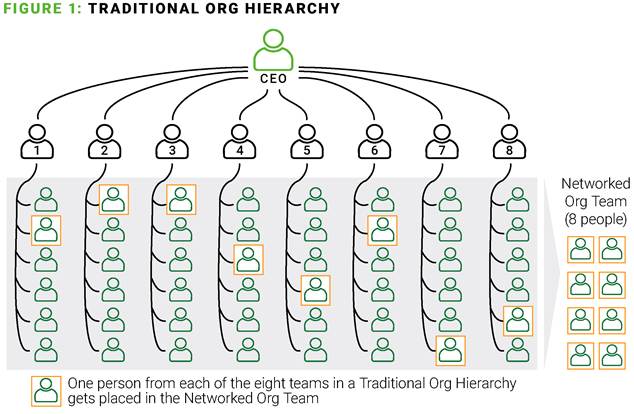
Figure 1 is an illustrative example of how a networked organization team can be formed by selecting top talent across traditional organizations to form a cross-functional team
Enablers of networked execution
Transitioning to a networked model requires more than new team charts. It demands a foundation of enablers that make distributed collaboration scalable:
Transitioning without destabilizing the core
The most successful organizations don’t rip out hierarchies. They layer networked execution on top, using pilots and transformation programs as proving grounds. This approach minimizes risk, builds credibility, and preserves enterprise discipline, while unlocking speed where it matters most.
Perhaps the most overlooked, but critical, element of this transition is a leadership mindset. Leaders must embrace ambiguity, relinquish control, and trust teams to self-organize around outcomes. This requires not just skills development, but often a redefinition of what good leadership looks like. Success is no longer measured by control over resources, but by the velocity and impact of empowered teams.
It also requires managing cultural friction. Legacy mindsets, incentive systems, and career models need to be revisited with networks in mind. Addressing these systematically, through change management, capability building, and communications, is vital for embedding the new ways of working.
The 2025 AlixPartners Disruption Index shows that outperforming, faster-growing companies are more likely to be proactive, agile, and resilient, while prioritizing execution and speed to results. Companies maximizing their use of AI, automation, and data analytics are those that have already embedded agile, networked principles, allowing rapid scaling of innovation without being bottlenecked by old hierarchies.
Transition is difficult. Expect resistance from those whose roles and authority are tied to the old system or ways of working. Effective change management, transparent communications, and clear personal incentives for those affected are critical.
Importantly, the move to a networked model does not require wholesale disruption. Many successful transitions begin with protected pilots that operate outside of traditional constraints. These pilots generate early wins, build internal champions, and create a blueprint for broader adoption. The key is to demonstrate tangible impact early on speed, cost, innovation, or customer satisfaction, while avoiding the pitfalls of over-engineering or premature scale.
Organizations need to be vigilant in ensuring that agility at the edges doesn’t result in chaos at the core. The entire organization must be shown, and buy into, the vision and provided with the tools and resources needed to achieve that vision. Strategic clarity and outcome-based alignment are non-negotiable. For networked models to deliver, they must be anchored by a compelling shared vision and robust operating discipline.
The payoff
When done right, the transition to a networked organization yields faster innovation cycles, lower costs, improved engagement, and fundamentally better customer outcomes. This provides a foundation for sustainable growth in an era when speed and adaptability are the best insurance against disruption.
In the final article in this series, we will highlight how we helped a client successfully implement a networked organization.
Part 1 in this series can be read here.