Demystifying the pricing of AI for SaaS incumbents
June 03, 2026 | 8-minute read
AI has created huge opportunities—and threats—for established SaaS companies, forcing them to rethink, retool, and reprice their offerings. Here, we dive deeper into the pricing implications of AI to provide guidance to SaaS management teams on how to address this challenge.
This is a topic widely debated among industry investors and operators. Most of the current discourse focuses on which pricing models and drivers will prevail. However, given the unprecedented scale of AI disruption, this answer is not yet clear—no one has a crystal ball to anticipate it with absolute confidence.
Instead, it may be more valuable to consider potential outcomes from a first-principles perspective. This is not so much to develop a reliable forecast of the industry's future, but to be well equipped to recognize and interpret market dynamics, enabling commercial decisions to be made with greater confidence and likelihood of success.
Structural factors at play
We see four core elements at the front and center in this environment:
1. AI has different economics from SaaS. The demand for compute and inference drives significant Cost of Goods Sold, lowering variable margin from the typical 80-90% of traditional SaaS offerings to 50-60%.
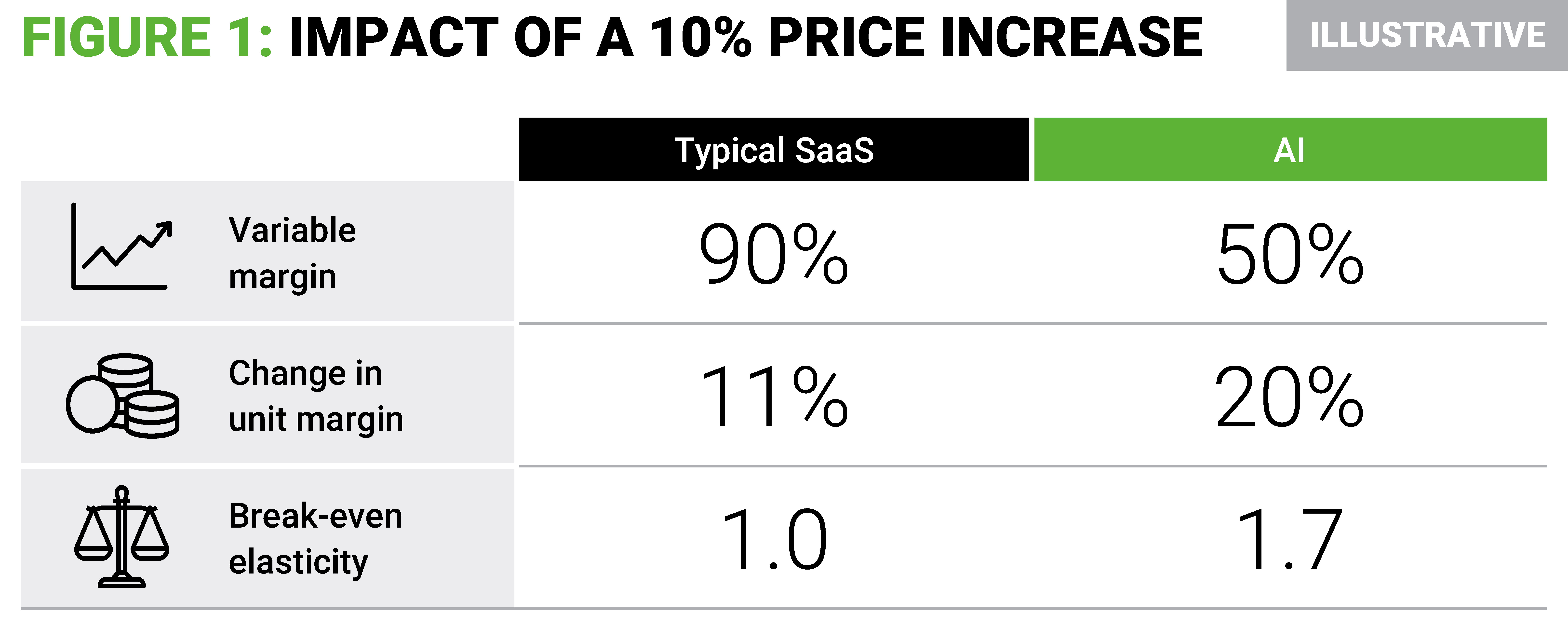
This has important implications for pricing; the impact of price changes on unit margin is greater, and so is the break-even elasticity. Let’s consider an illustrative example of a 10% price increase for AI agents with a 50% variable margin versus traditional SaaS with a 90% margin, as shown in the figure below.
Unit margins of agentic AI are more sensitive to price levels, and bigger volume swings are required to offset price changes, which provides more leeway for price rises but raises the volume hurdle to justify price cuts.
2. AI has the potential to bring deflationary pressures to SaaS software. This is both directly, by helping SaaS incumbents reduce the fixed cost of software development and indirectly, because AI-native players will need to recover their R&D investments and generate adequate returns on the billions of dollars they have raised. The latter is likely to drive “land grab” strategies involving heavily discounted pricing or even freemium propositions, but both dynamics may lead to price pressures.
3. AI will reshape the definition of SaaS value-add. While SaaS software is primarily a productivity tool to enhance workforce performance, agentic AI can replace staff, significantly reduce labor costs and potentially change customers’ cost structures. This may happen by augmenting existing SaaS offerings or by replacing them (in full or in part). Either way, SaaS vendors will need to fundamentally rethink the scope of their value-add, which requires a deep understanding of their customers' economics, priorities, and decision criteria.
While this might sound obvious, it is a big change for the SaaS sector, which is often characterized by a structural “value” gap. Software offerings are continually enhanced with new features to maintain price points, but customers often use only a portion of what they pay for.
A good illustration of this disconnect is the systematic monetization of ERP, payroll, and accounting software features via aggressive price tiering practices such as “escalator” pricing. Here, SaaS vendors routinely revamp their tiers by removing the cheapest “bronze-like” level at the bottom of their price architecture, while adding a new tier with the latest features at the top to drive upsell and ARPU. Over time, this pricing approach leads to a growing gap between the value customers pay for and the value they experience.
4. Business customers’ view of value is likely to stay the same in the face of technology advances. They buy an overall solution (rather than a collection of attractive features) and expect a compelling and tangible ROI. For them, AI is just a means to a business end, a better mousetrap. They want to cut through the hype surrounding AI and obtain clarity around a few key questions:
What are the potential benefits of the solution, and how will they play out? For instance, will new AI agents handling customer queries augment the productivity of existing customer support staff, replace them and reduce the overall cost of customer service, increase first-call resolution and NPS-lowering churn, or all of the above?
What are the key components of the solution that will secure those benefits and how do they compare across alternative vendors?
What are the operational implications and requirements to realize those benefits?
Lastly, what are the costs? Buyers operate within budgets, so clarity and cost predictability matter to them.
Guiding principles
Against this backdrop, there are practical recommendations to help SaaS businesses navigate AI pricing effectively.
Firstly, start with a deep understanding of the value the new AI solution brings to customers—not from your perspective but from theirs. What is most important to them, what they are most willing to pay for, and what are their key decision criteria?
This is often easier said than done. Take the recent example of an AI-native vendor of fraud and anti-money laundering detection software for financial institutions. Their sales teams were well versed in talking about the efficiency (and deterministic) gains that their solution would deliver: lower fraud losses and fewer false positive cases (thus avoiding the cost of unnecessary investigations) via its superior AI-based screening algorithms and faster, more efficient reviews of suspicious transactions thanks to better orchestration of data and workflows. However, they were less prepared to articulate the value of their solution from an effectiveness (and probabilistic) angle. For instance, fewer money laundering cases slipping through the cracks, and therefore a lower risk of hefty regulatory penalties; or faster transaction screening to improve the customer experience and reduce attrition and churn.
The complex nature of that rich solution made it difficult to define and assess its full potential ROI. It was also obfuscating the true key decision factors that would tip the prospect’s choice in the company’s favor. The sophistication of its AI capabilities was overshadowing the importance of other factors, such as a customer’s ability to influence the product roadmap or the quality of support teams in critical jurisdictions where the customer felt more exposed to financial risks. Sometimes, people were just as important as the code itself.
Why did all this matter? Because sales teams lacking that in-depth understanding were resorting to price discounts to secure deals that were already ‘won’, leaving significant money on the table.
Decompose your solution to construct a pricing model that is fit for purpose. What parts consist of entitlements to platform functionalities and are suitable for subscription-like fixed prices? What elements display economics that are dependent on resource consumption and need a variable structure reflecting the cost of goods sold? What features are directly linked to measurable outcomes and can be priced accordingly?
A good example is the new pricing model recently adopted by Clay, the provider of AI-native go-to-market solutions. They have separated the platform price (where the solution’s core value lies) from the data processing price (sold with no markup on underlying costs).
Today SaaS players have a wide range of price models and drivers to choose from. The challenge is not to pick the single one that can be the “silver bullet” for their pricing. Instead, they need to select a simple but effective mix, considering the pros and cons of alternative approaches. For instance, think of variable pricing. This may be linked to usage (as a proxy for customer value) or to resource consumption (aligned with the vendor’s cost of goods sold). The two are correlated, but they entail different levels of input cost risk sharing. Also, the pricing may be fully metered or tiered in bands: how difficult is it to measure price units? Or how, in the case of price bands, should overage be dealt with? And will customers prefer a simpler and more predictable tier structure or accept a per-unit charge given their usage profile? There is no catch-all answer here; it is horses for courses.
Whatever your pricing choices, keep it simple. It will take time for definitive playbooks to emerge. In the meantime, minimize complexity to help sales teams sell new solutions with confidence and explain their pricing convincingly.
Likewise, make it easy for customers to understand your pricing. One example is the use of tokens as a consumption-based charging model. While it may have merits in some cases, it is important to consider the additional difficulty of converting usage measured in technical terms into tokens and then into actual money; this long chain can make costs opaque and hard to forecast. In addition, the progressive decline in consumption costs and token prices may drive the need to renegotiate deals at each new software release.
Also, the psychological aspects should not be forgotten. Even in a B2B environment, they can influence customers’ behavior and create friction in the sales and adoption process. For instance, tokens can trigger a “taxi meter” effect, leading users to unnecessarily curb their use, which limits the solution's benefits. Similarly, lower price points may adversely affect value perception, as the AI offer could be seen as too cheap to be worthwhile.
Where to start
GenAI is still in its early stages of adoption, even though it’s moving fast. Until standard pricing models (if any) emerge, the default stance should be to avoid a “one size fits all” approach. Don’t be distracted by the hype around different pricing structures and focus instead on:
The true value of your offer. This is the top priority, and it requires developing deep insights into what customers value and how they choose: that will be your North Star in shaping an effective pricing approach. Think about how to build that intelligence, how to challenge and augment your sales team’s understanding.
How to best monetize that value. Given the complex nature of many AI applications, their features, and their impact, hybrid pricing models are likely to be the answer for the time being; in any case, this will also give you time to test and learn.
How to execute pricing decisions effectively and land their expected benefits. The business front-end requires careful thinking to support sales and account management. How will you upskill sales teams to identify the key decision-making factors beyond what prospects say? What guidance, roles, tools, and playbooks will help sales teams assess and explain the value of new GenAI features and their pricing convincingly? How will you migrate the existing customer base to new offerings and pricing models? And how can you elevate the deal desk from a financial tollgate to a commercial forum to discuss the business merits of a given deal, the real necessity for discounts, and the overall market feedback to the pricing choices made?
There is also much to consider on the back-end to support the chosen pricing approach. Do you have the commercial and finance capabilities to manage different pricing mechanisms? For example, the contractual frameworks to stipulate how excess usage will be tracked and charged for, the fact that tokens may be repriced in line with compute costs, alongside defined and measurable outcomes; the metering resources to track and charge for usage or outcomes as required; the KPIs to monitor commercial performance in an environment where ARR may be less representative of customer lifetime value and cost of goods sold carries a bigger weight in the P&L. And how will the overall changes be orchestrated in an integrated, end-to-end program to align the different organizational functions with the new pricing setup?
Pricing GenAI may be challenging, but the core question to answer is simple: how do you deliver good “value for money” and capture a fair share? It is easier said than done, but it can be done—as is the case for any non-AI offering. Just don’t let the AI hype distract you from getting the basics that really matter right.