
Karsten Lafrenz
Partner & Managing Director - Zurich


Switzerland’s manufacturing sector is one of the key pillars of the economy, encompassing diverse subsectors including precision instruments, advanced machinery, automotive components, and high-tech electronics. The sector benefits from Switzerland’s global reputation for quality, precision, and the premium “Swiss Made” positioning in international markets. Switzerland’s manufacturing industry (machinery, metals, precision instruments, electronics) generated around CHF 90 billion in total revenues in 2024, employs approximately 330,000 professionals in Switzerland, accounts for roughly 7% of GDP, and represents 26% of all Swiss exports.[1]
Despite persistent structural headwinds, including persistent currency strength, rising energy costs, and global supply chain complexity, the sector demonstrates resilience. The scale of the challenge is borne out in the AlixPartners 2026 Industrials Study, which found that Swiss industrial revenues fell 4.3% — the third-steepest decline worldwide, behind only France and the U.S. and ahead of neighboring Germany — against an international average of roughly 3%, with a further annual decline of around 3% projected for 2026 to 2028. According to the 2026 AlixPartners Disruption Index, manufacturing continues to face high levels of disruption across different categories, with a particular concentration in Regulatory and Technological pressures.
This article draws on three complementary sources. The 2026 AlixPartners Disruption Index — a global survey of business executives across regions and industries — frames the categories of disruption. The 2026 AlixPartners Industrial Study quantifies the structural market shift facing the sector, drawing on more than 1,200 industrial companies worldwide. Our own analysis of the most recently published annual reports of Swiss stock exchange (SIX) listed manufacturers gives insight into the disruption factors that the companies themselves identify.
Key disruption categories based on AlixPartners’ Disruption Index
Based on categories from the AlixPartners Disruption Index framework, manufacturing is impacted most strongly by Regulatory and Technological disruption. Regulatory pressures are most prevalent, affecting 68% of firms, driven by ESG reporting requirements, carbon reduction mandates, and compliance obligations across export markets. Technological disruption affects 62% of firms, reflecting the accelerating Industry 4.0 transformation, automation requirements, and AI adoption in production processes.
Environmental concerns affect 51% of companies, reflecting growing focus on sustainable production and circular economy principles. Economic factors impact 26% of firms, primarily through inflation, interest rate volatility, and demand fluctuations, while political tensions affect 13% through trade restrictions and geopolitical uncertainties.
Manufacturing’s Regulatory disruption exposure is broadly in line with the cross-industry level, while Technological disruption is notably above the cross-industry average. This gap reflects the particular intensity of Industry 4.0 transformation demands on manufacturing firms relative to other sectors.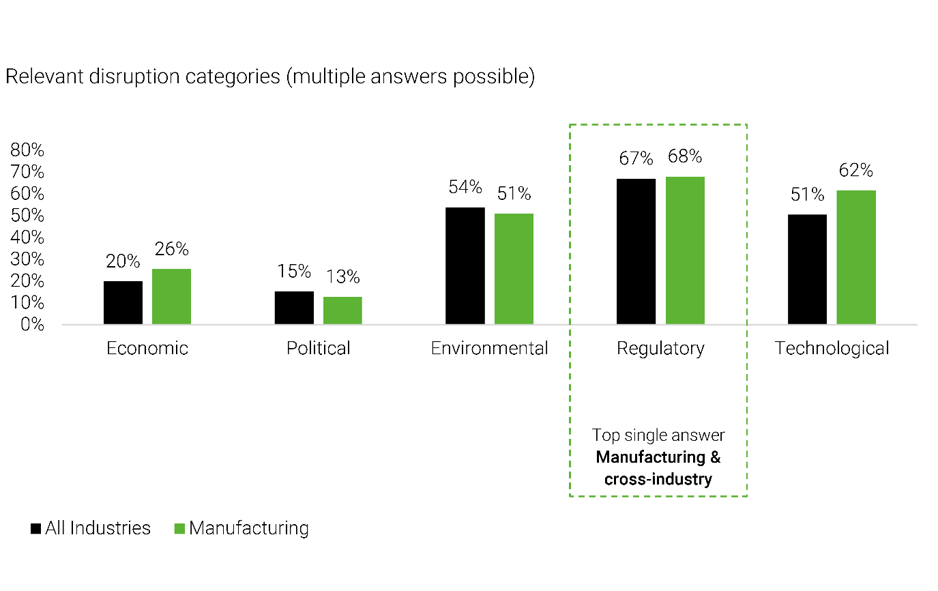
Key disruption factors as reported by Swiss companies
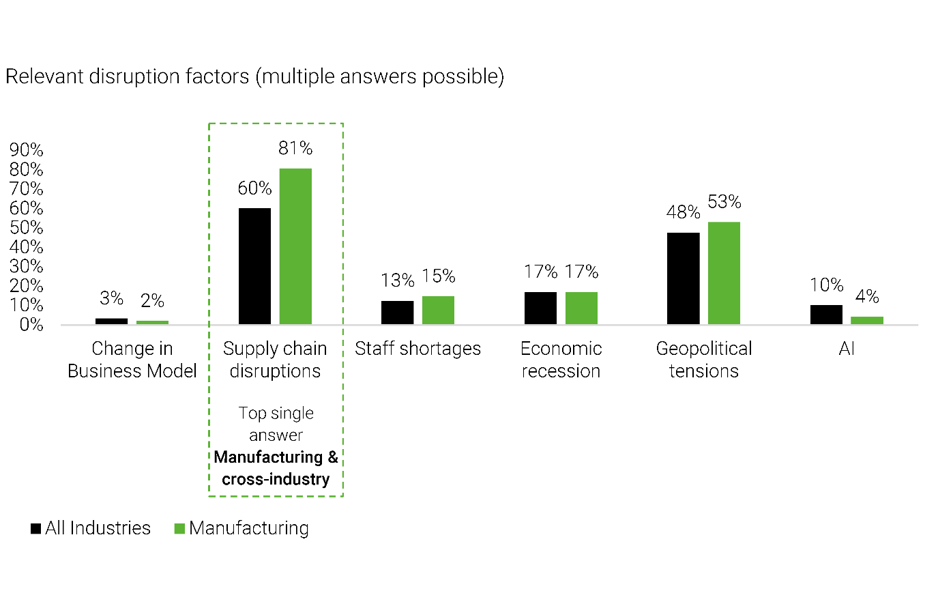
Supply chain disruptions affect manufacturing companies as the most important factor by far, with 81% of firms identifying it in their annual reports, well above the cross-industry level of 60% and the highest rate among all sectors analyzed. This reflects complex global supply chains exposed to availability, accessibility, and affordability issues.
Geopolitical tensions are named as the second most important factor, affecting 53% of manufacturing firms, slightly above the cross-industry level, through export restrictions, tariffs, sanctions, and market access challenges. Most recently, tariffs in important markets such as the U.S. have added another layer of complexity and insecurity across the sector.
Staff shortages rank third, affecting 15% of firms. AI as a structural disruptive force is currently identified by only 4% of manufacturing companies, significantly below the cross-industry level of 10%. Looking ahead, AI’s role as a disruptive force is only set to grow as Industry 4.0 adoption accelerates across the sector.
Swiss manufacturing companies analyzed demonstrate stagnating revenues, with average sales growth of -0.4%, and EBIT margins below the cross-industry median at 7.9%. However, companies that actively address disruption factors clearly outperform those that do not, achieving median growth rates that are 9.4 percentage points higher and median margins that are 4.9 percentage points stronger.
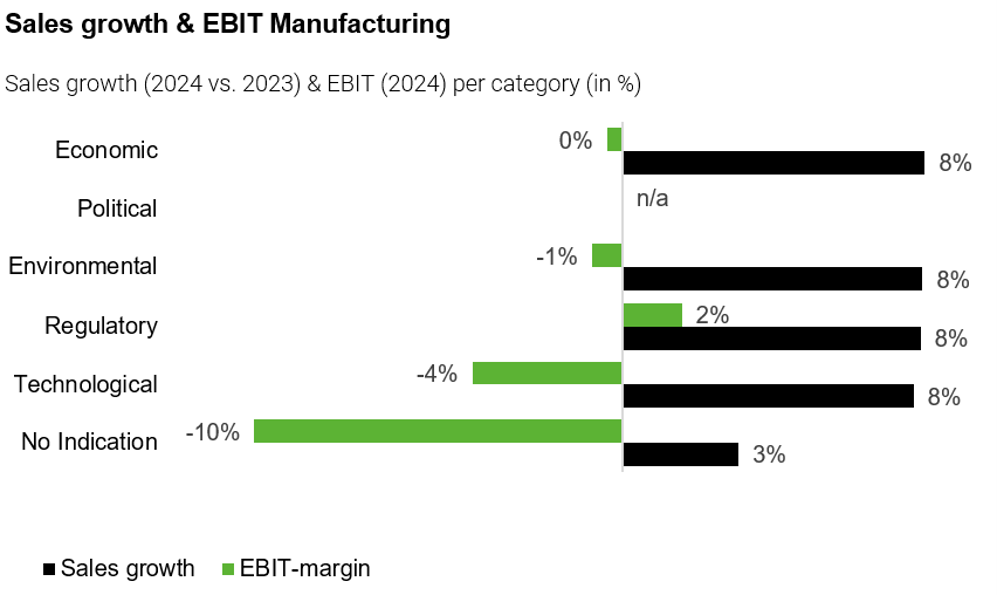
The performance of individual manufacturing firms varies depending on the disruption categories they identify in their annual reports. Across disruption categories, the impact on revenue growth is relatively limited, with companies that address disruption factors growing within a narrow range of 7.7% to 8.0% (median).
In contrast, the impact of disruption factors on profitability differs significantly across disruption categories. Technology disruption is associated with markedly negative median profitability of -4.0%, while the effects of economic (-0.4% median) and environmental (-0.8% median) disruption factors are comparatively moderate. Regulatory disruption, by contrast, appears to create opportunities, as companies that address this disruption category show a positive impact on profitability.
Companies embracing disruption unlock substantial value creation potential. With respect to the disruption categories highlighted above, this translates into opportunities:
The disruption factors point to equally concrete opportunities:
In light of persistent macroeconomic turbulence and export headwinds, manufacturing companies may struggle to sustain past performance levels. Traditional manufacturers without digital capabilities will continue facing structural margin pressure and business model challenges as Industry 4.0 adoption by competitors accelerates. Competitive pressure from China is a particular concern: the Industrials Study notes that Chinese competitors now dominate around 70% of global market share in critical technologies and produce at up to 40% lower cost at comparable quality, while Swiss labor costs of roughly USD 70 per hour run five to six times the Chinese level — eroding the premium positioning on which much of the sector has relied. Companies with legacy production systems face declining margins, market share erosion, and difficulty attracting engineering talent.
For Swiss manufacturing companies, cost management will be critical:
After several rounds of cost-cutting, the obvious levers are exhausted in most companies. The next wave of savings won’t come from doing the same things cheaper. It must come from a critical reassessment of the operating model itself to initiate genuine structural transformation.
Building on the AlixPartners Industrials Study, three strategic paths can help Swiss manufacturers reposition: a niche strategy that concentrates on highly specialized premium segments with rigorous cost discipline; a localization strategy that builds local value chains in growth markets such as China and India, often under a second, lower-priced brand; and an evolutionary strategy that develops local-for-local products under the same brand with a fully localized supply chain. Across these paths, three growth levers are decisive: targeted M&A to accelerate market entry, systematic innovation to defend the premium position, and aftersales, where top performers already generate 50 to 60% of revenues at two to three times the margin of new-equipment sales.
In manufacturing, the companies that move first and anticipate disruption will reap the greatest rewards from their transformation.
[1]Swissmem Branchenkennzahlen Q4/2024, Besta-Statistik (BfS).
More articles of this series: