
Eric Wobig
Partner & Managing Director


You’re hearing it constantly: Outcome-based pricing will replace per-seat licensing across the enterprise software industry. But should you make the switch now, wait, or ignore the warning altogether?
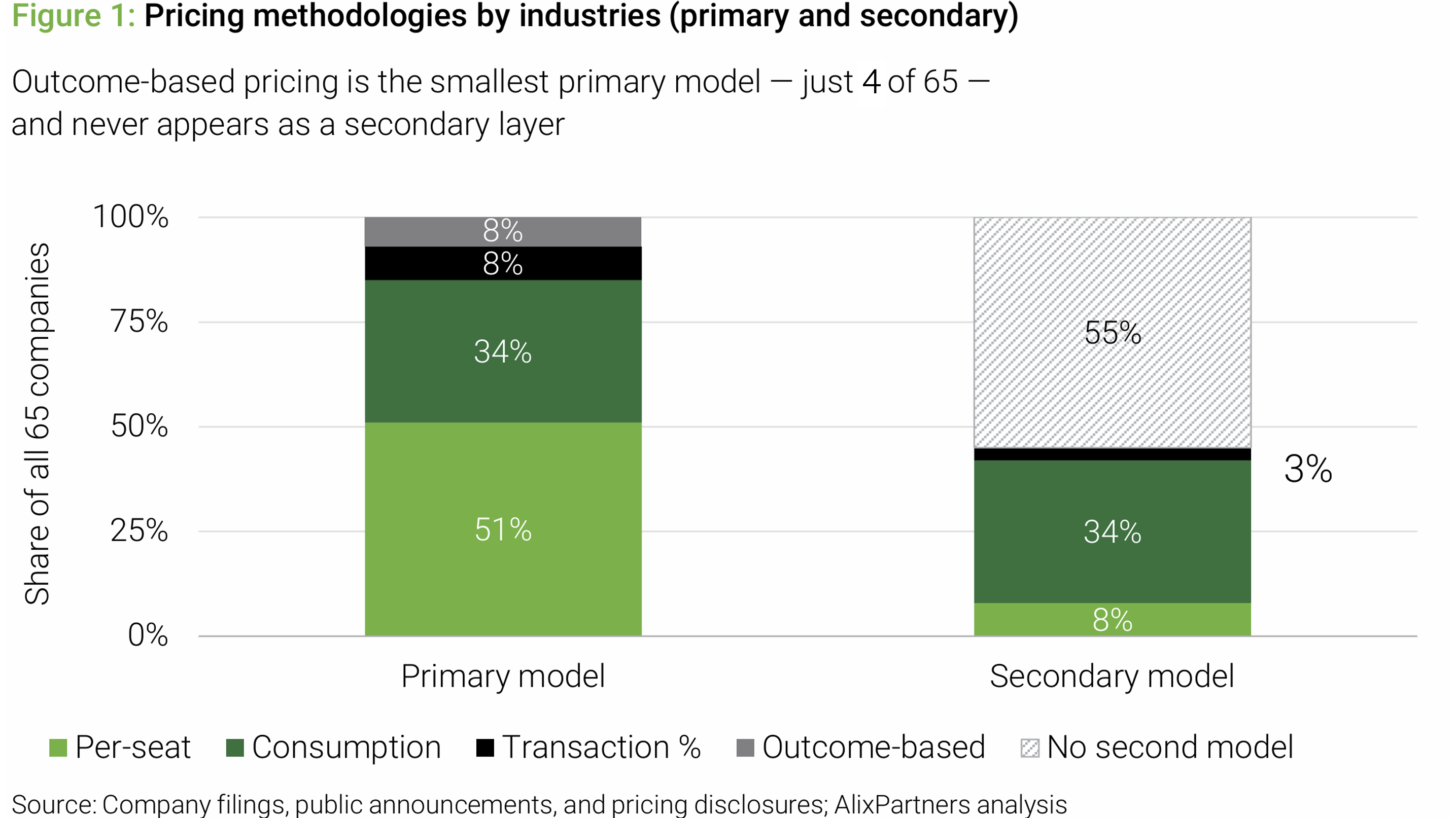
We analyzed 65 major SaaS companies and AI-native competitors to find out how many have thus far made the shift. Our analysis reveals a slower, more uneven reality than expected—only 4 of the 65 have fully adopted outcome-based pricing, and of the remaining 61, more than half still rely primarily on per-seat models.
While few have fully adopted, 72% have a hybrid approach that incorporates consumption through AI credits or usage metering, even as they continue to generate revenue regardless of whether customers achieve desired outcomes.
As customer expectations intensify, companies face a complex set of conditions to make the right move at the right time. Moving to outcome-based pricing too early risks cannibalizing per-seat revenue. Moving too late risks ceding market position to competitors. Below, we lay out the criteria for how to choose.
The enterprise software industry's per-seat pricing model worked well until it didn’t. In the AI era, buyers no longer need 20 licenses when a single agent can handle that same 20-seat workload.
Not all software companies face the same level of risk. Within the same company, an anchor product may be priced per-seat with a secondary consumption model layered on top. Around half of the 65 companies in our cohort followed this model. While they still depend on the per-seat model, some level of consumption-based activity provides an initial mechanism to tie pricing to usage.
Understanding a company’s exposure to three structural conditions is fundamental to developing an effective pricing strategy:
The first is a high concentration of seats in automatable workflows. Companies whose products support repetitive, rules-based tasks, such as customer service or IT ticketing, face the most immediate pressure. If an AI agent can handle the core task, the value-per-seat argument weakens with every deployment cycle.
The second is selling into functions where AI ROI is easily measurable. When a buyer can calculate what an AI agent saves per ticket resolved or per lead qualified, the pressure to tie pricing to that outcome intensifies. All four companies in our cohort with confirmed outcome-based pricing operate in customer service or customer-facing agent workflows where outcomes are discrete and verifiable. Vendors in harder-to-measure domains have more runway, but it is shrinking.
The third is the use of secondary pricing models in addition to seats. Companies on pure per-seat models, without a usage-based or outcome-based layer, have fewer levers to pull when buyers push to link payment to performance rather than to licensed users.
The companies at the intersection of all three—high seat concentration in highly automatable tasks, easily measurable outcomes, and limited pricing flexibility—face the most urgent need to act.
The pricing model that a company chooses determines how risk is shared across customers and vendors. Exhibit 2 plots all 65 companies on a single axis into one of three categories: 53 where the customer bears the risk (e.g., primarily seat-or consumption-based models), 8 where it is shared, and just 4 where the vendor bears it (fully outcome-based). This means that for 82% of companies, customers take the punishment if the software doesn’t deliver.
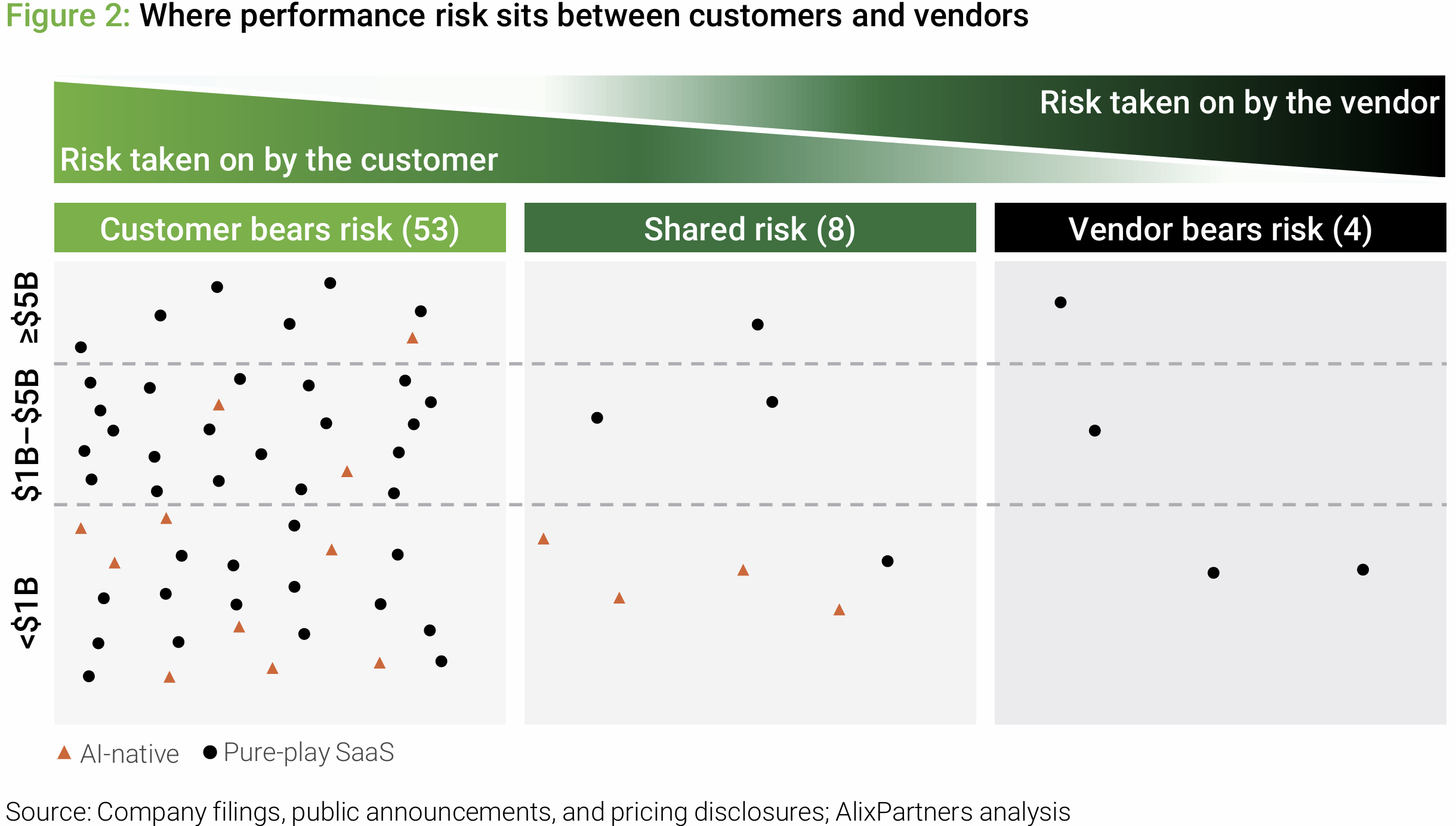
The pattern is similar when examining companies by revenue. Seven of the nine companies with more than $5 billion in annual revenue are in the customer-bears-risk group. Those companies that are willing to accept the downside of the outcome-based model are clustered in the sub-$1 billion group. Furthermore, these companies are in customer-service workflow and transaction-volume businesses, where outcomes are more easily measurable than in many other applications.
Understanding the common characteristics of the genuine outcome-based pricing model can help determine where the competition will move next. We identified two key characteristics:
Workflow specificity: All four companies’ products address customer service and customer-facing support workflows. They automate narrow, well-defined tasks by autonomously resolving inbound customer queries. The outcome is binary: Either the ticket closes, or it does not.
This model can be distinguished from other output-based AI categories with subjective outcomes. Code generated by a coding agent, for example, may or may not be “correct” or “valuable” to the end user. That’s the crucial diagnostic: Can you measure success in a way your customer will accept?
Market reference pricing: Another quantifiable characteristic is a product that competes directly with human labor and has a known, fully loaded cost per unit of work. Dividing that cost by the average number of tickets handled per shift provides a benchmark for comparing the cost per AI-resolved ticket.
The resolution rate determines whether outcome-based pricing is viable. The AI agent’s success rate in reliably resolving a sufficient volume to generate a per-resolution fee below the customer’s fully loaded human-agent cost sets the viability benchmark. Workflows with high, measurable AI success rates support an outcome-based model, whereas those with inconsistent, hard-to-measure outputs do not.
Given that these characteristics are increasingly present across categories, we expect the current outcome-based cohort to grow.
Incumbents can use a three-step approach to assess their downside risk and upside potential:
Measure seat concentration in automatable workflows. Identify the share of revenue that comes from AI-agent tasks such as ticketing, routine analysis, and basic content generation. If the share is high, per-seat pricing will be under pressure.
Analyze the flexibility of your pricing model. Per-seat pricing leaves you exposed when buyers use automation to argue they need fewer licenses. Adding a usage-based element doesn’t remove that pressure or the customer’s performance risk, but it does create a second pricing dimension and a route to usage- or outcome-based terms. Vendors that rely only on per-seat pricing have the least room to maneuver.
Test outcome measurability. Expect buyer pressure when outcomes are discrete, failure is binary, and market-reference pricing favors AI agents. If these conditions are not met, per-seat pricing or usage-based models will hold, and the urgency shifts to identifying and defending seat value.
For vendors whose workflows fit, moving to usage- and outcome-based pricing is a growth play, not just a response to buyer pressure. When revenue is tied to the value AI delivers rather than the number of seats, the upside increases. A customer that once bought 200 CRM seats may now pay more as AI handles more volume and the vendor earns on each resolved interaction.
The recurring model stays in place; only the billing unit changes. That shift lets vendors capture the upside, not just defend against the downside.