
Jerry Wang
Partner & Managing Director - New York


The pressure on payers, employers, and health systems to control specialty drug spending has become an engine of growth and deal activity for the $30B a year U.S. ambulatory infusion market.
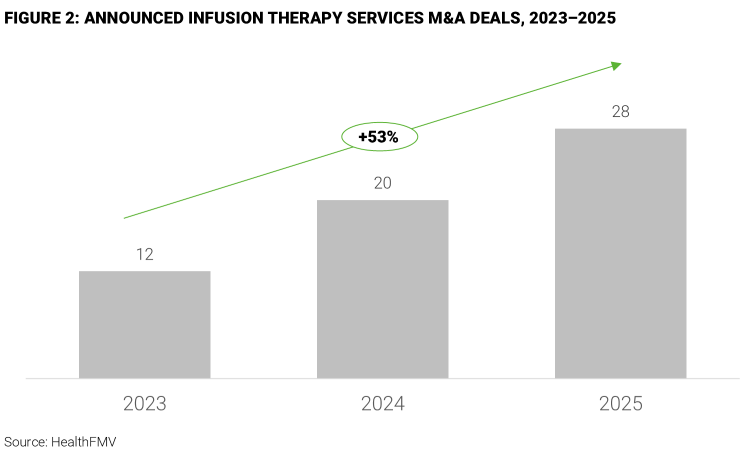
The shift of infusion out of the hospital is structural for operators and investors, with annual growth running above 10%, attracting capital and accelerating consolidation against a backdrop of rising valuations.
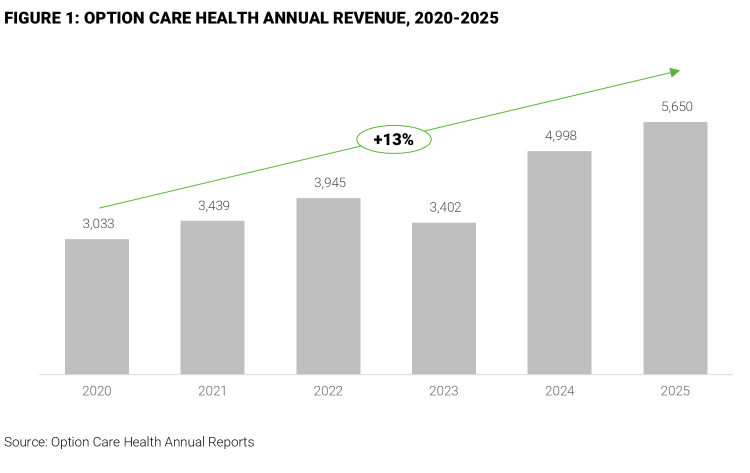
The recent $5.8 billion deal by CD&R and McKesson to acquire Option Care Health removes the largest independent operator and increases the scarcity of remaining players.
AlixPartners' latest healthcare executive survey revealed the disconnect between appetite and readiness for M&A. Value will flow to the platforms and buyers with a disciplined playbook that proves earnings durability, builds payer-aligned density, and makes integration repeatable.
Private equity and strategic buyers are drawn to infusion by payer momentum behind lower-cost sites of care, a specialty pipeline that keeps feeding demand, a fragmented provider base, and valuations that reward scale.
Recent platform deals have pushed toward 20x EBITDA, up from single digits and low double digits in the early 2010s, according to HealthFMV. At those multiples, there is little margin for error. Buyers paying for growth need confidence that earnings will hold and that each acquisition will create value through realized revenue and cost synergies, making readiness the deciding factor in who captures the premium.
The buy-and-build playbook still works, but only where the operating model works at the site level and the drug-margin thesis survives policy and pricing scenarios. Rolling up sites without fixing payer contracting, referral conversion, and labor productivity simply scales the problem.
Build the evidence, integration discipline, and the proof points buyers now demand. Operators and investors who treat this window as a forcing function will be best positioned as the next wave of consolidation plays out.
The economic and clinical case rests on the 30% cost advantage that alternative sites hold over outpatient departments. With comparable outcomes at materially lower cost, payers have every incentive to continue steering volume away from the hospital, giving alternate-site providers a durable demand tailwind that underpins the investment thesis.
Newer ambulatory models are built around private suites and convenient parking rather than the hospital outpatient environment. Recent M&A activity highlights a laser focus on patient and provider experience driven through alternative sites of care. For buyers, experience builds referral loyalty and patient retention, turning service quality into a competitive moat that supports volume and valuation as platforms scale.
The pipeline feeds the channel
The pipeline is also deep. According to Food and Drug Administration data, almost 50% of FDA-approved novel drugs over the past five years have been injectables. Infusion providers, which sit downstream of that innovation, supply the infrastructure to administer and reimburse these complex specialty therapies safely outside the hospital.
McKesson cites continued innovation in specialty, rare, and orphan therapies, together with the increasing need for alternate infusion services, as a long-term growth opportunity in the Option Care Health press release. As more of that spend shifts to complex, high-cost infused therapies, platforms with the clinical capabilities and payer access to administer them are positioned to capture a growing share of the most valuable volume.
CVS Health’s Coram left an estimated 15% of the market open when it stopped accepting new referrals for antibiotics, inotropic medications, and other acute home infusion therapies in October 2024.
The opportunity rewarded providers with the capacity, payer contracts, and geographic reach to absorb displaced volume and accelerate the push toward scale through acquisition.
The M&A imperative
Buyers are pursuing these deals to build scale, broaden scope, and capitalize on a fragmented market:
Scale and market share. Larger providers with multiple sites in high-growth markets and strong referral bases attract strategic and private equity buyers.
Payer leverage and network access. With payers narrowing infusion networks, a broader footprint and an integrated contracting and operating platform strengthen a provider’s position.
Therapeutic breadth. A broader portfolio also diversifies exposure to any single drug or category.
Referral density. Deeper ties with referring specialists and payers within a market drive more predictable volume and faster site ramp-up, making each acquisition more valuable than the last.
Fragmentation. A market with many small, independent providers offers a long runway of add-on targets, allowing platforms to build scale and capture value through consolidation.
Priorities for M&A readiness
Whether the goal is to sell, to scale through add-ons, or to underwrite a platform, readiness comes down to the same three priorities. AlixPartners’ 2026 HLS Survey shows why readiness matters: strategic M&A and AI are the top two priorities across respondents, yet only 27% are very confident in their ability to conduct strategic M&A on an accelerated timeline.
1. Prove earnings quality and durability.
Demonstrate that revenue will hold. Stress-test the drug and therapy mix against biosimilar entry, Part B pricing scrutiny, and payer policy changes; track referral volume and conversion; and secure in-network contracts with a diversified set of commercial payers. Heavy reliance on Medicare and Medicaid, or lack of in-network status with key payers, results in a discount from buyers.
Prove margins at the unit level. Contribution margin per infusion and per chair, cash collection, and denial rates show buyers how efficiently the business converts volume into earnings.
Make earnings verifiable. Accrual-based, GAAP-compliant financials and a clear normalized EBITDA bridge separate recurring earnings from one-time items, and fair-market-value support for hospital or physician joint ventures shows those earnings will hold up under regulatory scrutiny after close.
2. Build payer-aligned density, not just site count, so each deal is faster to underwrite and ramp.
Match the site mix of home, suites, and ambulatory centers to payers’ site-of-care policies, and map the markets with deep referral demand. A clear view of where density can be built lets platforms screen and prioritize add-on targets quickly rather than chasing site count.
Diversify referral sources and measure the referral-to-first-infusion conversion rate. A diversified referral base delivers more predictable volume, and conversion data already in hand shortens commercial diligence; a narrow base is a risk buyers will price in.
Document outcomes, adherence, and safety. The same evidence payers use to steer volume to alternate sites strengthens contract negotiations and answers diligence questions before they are asked, keeping deals on schedule.
3. Demonstrate synergistic value creation is tangible and achievable.
Set explicit revenue and cost synergy targets for every acquisition before close. Standardize clinical protocols, scheduling, inventory, and billing so each new site plugs into one operating model.
Deliberately capture revenue synergies by extending the strongest payer contracts across acquired sites. Cross-reference between home and ambulatory channels, and add therapies in new markets, while protecting referral relationships and contract terms through the transition.
Drive cost and efficiency synergies through unit economics at the chair and nurse level. In a labor-constrained market, productivity per clinician is where buyers see whether a roll-up compounds or adds overhead.
Prove AI returns on one or two deployments, not a portfolio of pilots. AlixPartners’ survey found investors and advisors more bullish than operators, and fewer than 30% of operators that have implemented AI solutions say true ROI is currently measurable. Proven AI use cases and successful pilots increase confidence in the achievability of targeted efficiencies, enabling investors to underwrite the benefits more credibly.
In infusion, strong first candidates include automating benefits verification and prior authorization to speed referral-to-first-infusion and reduce denials. Use demand forecasting and no-show prediction to align nurse and chair capacity with scheduled volume, both of which tie directly to measurable gains in revenue capture and clinician productivity.
Track synergies through to realization, not just integration milestones, and build the playbook before the second and third acquisitions, not after. Integration without value capture adds complexity and cost; platforms that add sites faster than they realize synergies scale the problem.
Lessons for investors and operators
Private equity and strategic buyers are drawn to infusion by payer momentum behind lower-cost sites of care, a specialty pipeline that continues to fuel demand, a fragmented provider base, and valuations that reward scale.
The buy-and-build playbook still works, but only where the operating model works at the site level and the drug-margin thesis survives policy and pricing scenarios. Rolling up sites without fixing payer contracting, referral conversion, and labor productivity simply scales the problem.
Build the evidence, integration discipline, and the proof points buyers now demand. Operators and investors who treat this window as a forcing function will be best positioned as the next wave of consolidation plays out.