
Andy Eversbusch
Global Vice Chair, Partner & Managing Director
New York
Andy Eversbusch
Partner & Managing Director - New York


From an AI impact perspective, large, global industrial companies are an interesting group to analyze. They are typically highly complex, capital-intensive, and technologically sophisticated enterprises, where achieving consistent high performance requires doing the right things and doing them well. Unlike certain pure software and technology-enabled companies whose very existence may be threatened by AI, large industrial companies, for the most part, don’t face an existential threat. They do face significant disruption from AI. But there is also considerable opportunity. The key question is where and how to deploy AI for the greatest impact. That is what we want to unpack.
But first, we need to lay the groundwork for what, in our view, underpins strong and consistent industrial company performance. Specifically, we see three essential elements that make for winning performance systems in today’s environment:
Every high-performing company focuses on one clear, widely understood definition of winning: a single measure that every function, investment decision, and incentive is optimized against. Without it, functions tend to pursue competing definitions of winning and the system fragments.
A company’s shared definition of winning needs to be the right one, measured the right way, because a system will enforce whatever measure it is given. Consider a large diversified industrial company that spent years running a highly regarded management system. Operating margins roughly doubled, and returns on capital moved from around the cost of capital to comfortably above it.
But the company had defined winning as margin and return percentages. Over time, that discipline led it to pass on profitable, strategically important growth that would have added shareholder value but diluted its margins. It lost share of the most attractive profit pools, eventually drew activist attention, and ended in a breakup. Ultimately, the system did exactly what it was built to do. It was just built around the wrong definition of winning.
The best definition of winning for an industrial company is economic profit growth over time: growth in earnings above the cost of the capital used to generate them, sustained over years rather than quarters or a single strong year. Total shareholder returns follow economic profit growth. Expanding your share of attractive profit pools is how you deliver that growth.
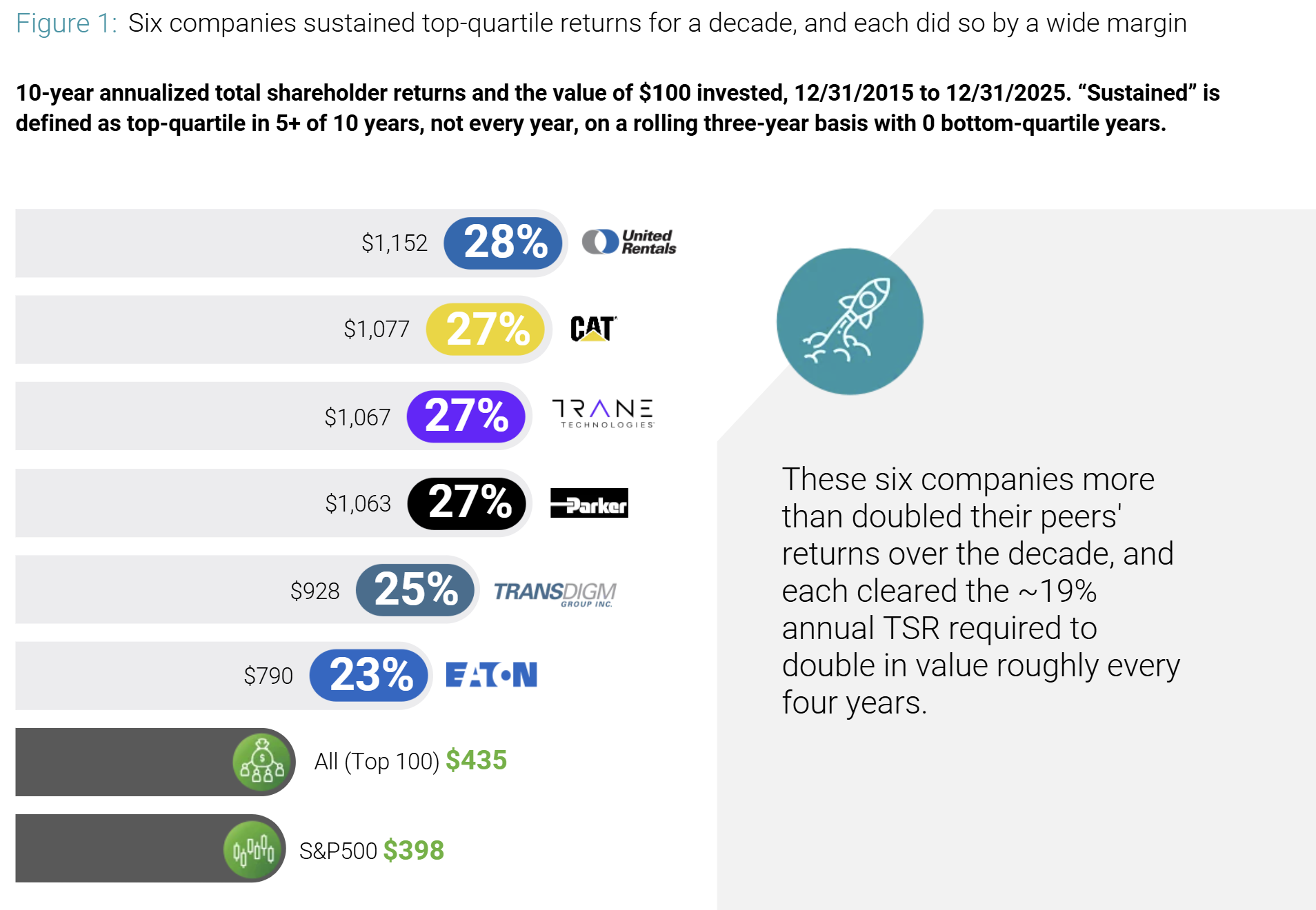
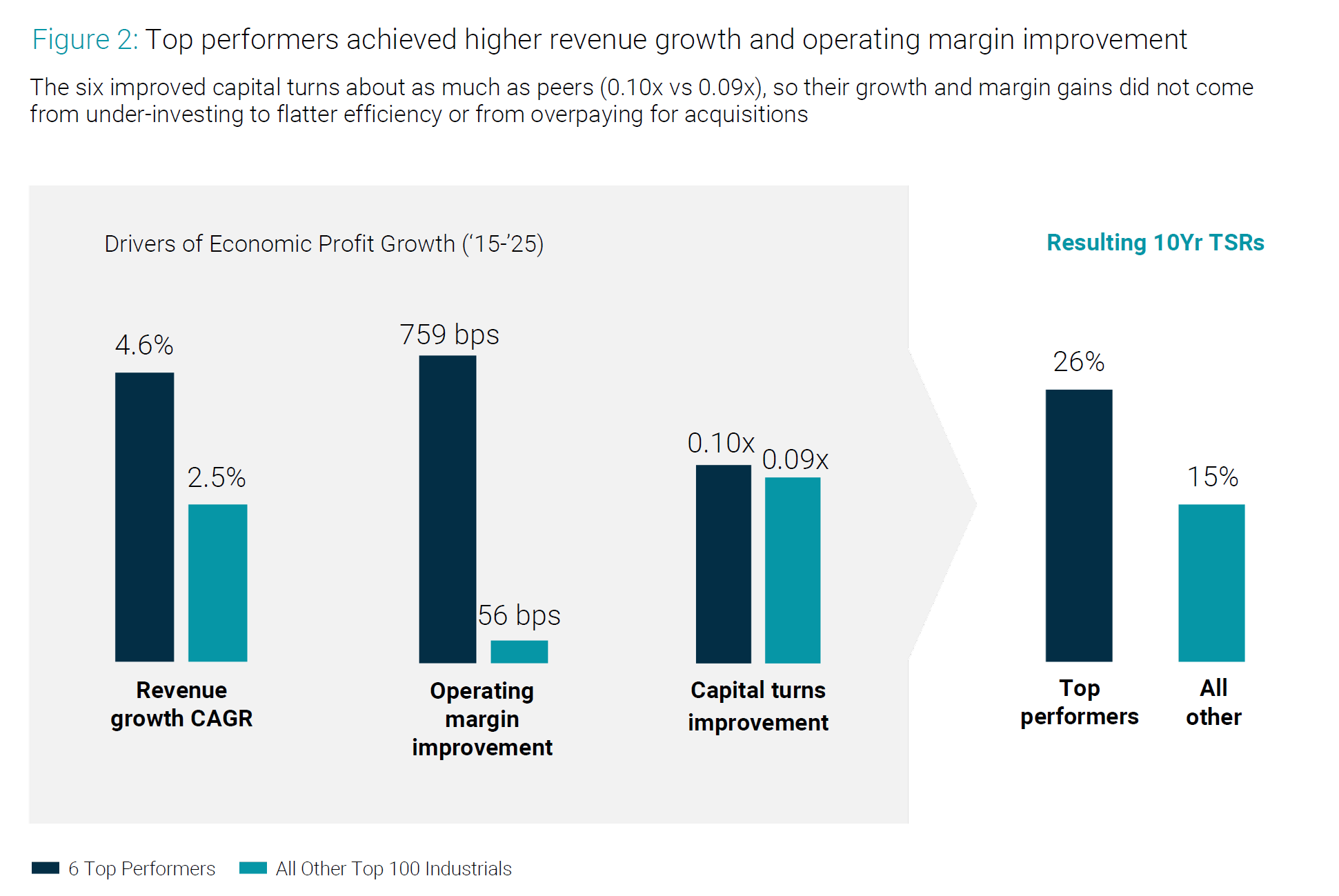
Sustained economic profit growth requires revenue growth, margin expansion, and capital efficiency working together, rather than as independent line items optimized in a carousel of competing goals. The six top-performing industrial companies improved capital efficiency about as much as their peers, but grew revenue and expanded operating margin far faster than the rest of the top 100. A cost program or new product launch can lift margins for a few years. Delivering all three for a decade takes a performance system.
Establishing an effective performance system starts by analyzing your business in granular detail. Most management teams believe they know where their business makes money. Far fewer can show it in enough depth to know where the next investment dollar should go: which market segments, customers, products, and geographies earn well above the cost of capital, which barely cover it, and which destroy value. The external and internal profit concentrations that granularity reveals are what make a definition of winning actionable rather than aspirational.
Once the definition and the measure are right, they should not change. Their permanence is what makes them powerful, because every function, investment decision, and incentive can then drive toward the same outcome, quarter after quarter, year after year. What does change is the business environment. Profit pools shift, sometimes quickly, so leading companies regularly revisit where they are aiming their resources while holding the measure of success fixed.
With the right profit pools identified, the key leadership task becomes aligning the whole business behind them.
A definition of winning tells a business where it is going. The three Rights are how it gets there. Each is earned differently and does a different job: the Right to Play keeps the business in the game, the Right to Win builds competitive advantage, and the Right to Sustain makes that advantage last. A company needs all three to have enduring success.
The Right to Play covers the fundamentals required to compete at all: the competencies, performance, and cost structure needed across product development, supply chain & operations, marketing & sales, and the aftermarket. These capabilities erode quietly when leadership attention drifts, and the erosion is often invisible until it becomes very expensive to fix. Most decline stories begin here rather than with a strategic misstep.
Ford is a great example. In 2010, Ford ranked highest among non-luxury brands in J.D. Power’s Initial Quality Study. By 2023 it had slipped to 15th among mainstream brands, and it paid nearly $4.8 billion in warranty claims that year. In June 2026, Ford once again ranked as the top mainstream brand in the study. The return came from years of unglamorous work across engineering, supply chain, and manufacturing, and it showed up in the economics: Ford says it reduced warranty and material costs by $1.5 billion in 2025, adjusted for volume and mix. The value of the Right to Play is most visible when it is missing.
The Right to Win is a short list of deliberate choices about where a company will be genuinely better than its competitors: which markets and profit pools to pursue most aggressively, which products and services to push, and which investments to make. These choices are challenging and expensive to deliver, which is exactly why they create an enduring edge over competitors. The most common failure in this area is hedging, with resources spread too thin for any initiative to create competitive differentiation or gain momentum.
The key is to focus on profit pools your business is uniquely well-positioned to serve. Caterpillar chose services, a profit pool anchored in an installed base of over four million products and a network of around 160 independent dealers. As part of the investment, the company built Helios, a single, proprietary platform for customer and asset data. Over the years, the Cat Digital team that created Helios grew from about 600 people to nearly 3,000. Caterpillar now has more than 1.6 million connected assets and uses that data to alert dealers to service needs before machines fail. Services revenues reached $24 billion in 2025, up from $14 billion in 2016. One profit pool, chosen deliberately and funded for a decade, built unique value for customers that itself is a durable advantage.
The Right to Sustain is the company’s management system: the architecture and backbone of how the business runs. It is not an individual tool, team, or capability. It defines key processes, how decisions get made, how issues get fixed, and where resources go. And it has to keep working as leadership, strategy, technology, and markets change. All six top performers run named, well-defined management systems.
The Eaton Business System, for instance, has had a dedicated executive owner reporting to the CEO since 2003, across two chief executives. It governed the company through the $3.3 billion sale of its hydraulics business to Danfoss in 2021 and reinvestment into electrical and aerospace. Eaton’s portfolio changed substantially, but what differentiated the company did not. That continuity across leaders, strategies, and markets is what the Right to Sustain provides.
Sustained outperformance requires earning and consistently maintaining all three Rights, which is why so few companies manage to sustain top performance over extended time frames. What each Right demands has not changed, but the performance frontier each is measured against has. AI is now raising the bar across all three Rights.
AI is widening the gap between leaders and laggards. What separates them is how they use AI rather than which technology they buy or how many pilots they run. Leading companies know which applications simply keep them level and which build a real edge, and they fund each accordingly.
Much of the value AI creates in industrial businesses is operational: predictive maintenance, forecasting, AI-assisted engineering, and back-office automation. That value is real, but because it is available to everyone, it quickly becomes table stakes: necessary to keep pace, but not enough to pull ahead. This is Right to Play value. Fund and embed it with discipline, but avoid believing that it alone ensures differentiation. Agentic transaction processing is a good example. It cuts costs and improves service, but as competitors do the same, it stops being a way to widen margins or deepen your competitive moat.
The second kind of value comes from accelerating proprietary advantages. AI built on operating history and proprietary data can create an edge that competitors cannot easily copy, and even open up entirely new profit pools. These advantages take longer and cost more to build, which is exactly why they last. This is how AI can be used to earn the Right to Win.
Caterpillar’s Helios is one example of this. John Deere is another: in 2017, it acquired Blue River Technology and launched See & Spray in 2021. The system uses cameras and AI to identify individual weeds at up to 15 miles per hour and spray only where it finds them. In the 2025 season, it ran on more than five million acres and cut non-residual herbicide use by an average of nearly 50%. Deere charges for it under an application savings guarantee, so customers pay only when the savings materialize. Deere now earns from how the machine performs in the field rather than only from selling it, and those savings encourage customers to buy more of its AI-enabled equipment.
What makes this advantage durable is almost a decade of proprietary crop imagery, an established base of in-use machinery, and a dealer network to support it. The AI model itself is the easiest part to copy.
The Right to Sustain is where AI can be most difficult to achieve value from, but is also the most enduring. It involves shaping and advancing the company’s entire management system for better, more timely, and more accurate decision-making, more agile corrective actions, and more resilience to disruption.
Today, the companies getting this right are few and far between. The AI environment is marked by confusion, inconsistent returns, rising costs, safety concerns, and pushback from employees and society. Yet AI is becoming the great divider, less as a technology than as a test of organizational agility, strategic clarity, and execution.
We estimate that around 80% of AI programs fail to deliver meaningful business improvement. These failures can stem from a lack of reliable data or robust technology foundations. But they usually occur because leadership teams neglect the fundamentals that form their Right to Play, lose sight of the profit pool focus and differentiation that establish their Right to Win, or relax the governance discipline that underpins their Right to Sustain.
Focus on the right things from the start
Most AI programs chase the easiest use cases rather than the most valuable. Start from the P&L and the strategy, find the two or three levers that matter most to enterprise value, and secure C-level sponsorship before the first build. Quick wins are hygiene, so let IT own them while leadership attention goes to the big rocks.
Do it right
Automating today’s processes locks in today’s inefficiencies, so redesign the work before applying AI, and set cost and risk limits for each workflow early. Hold every initiative to the same discipline as any other capital decision, sized with finance in economic profit terms. Ideas too early to clear that bar can be funded separately, through a venture-style internal fund seeded once and expected to earn its way to the next round of investment.
Attack data from the start
Data work is routinely underestimated and is the most common reason AI programs stall. You cannot build good AI on bad data, but you also cannot wait years for a broad data program. Get the data fit for each priority workflow quickly, knowing that much of the value comes from connecting information that previously sat in silos.
Bring people along
AI programs run as technology projects fail to gain adoption because employees reject what they did not help shape. Adoption depends on two kinds of trust: that the output is accurate, and that the tool will help people do their jobs better. Plan the change with employees, suppliers, and customers from the start, and redesign roles with the people who do the work.
Execute with the right team
Teams that build without operators who know the domain deliver technically sound solutions that miss the business point. Decide who builds each piece, whether your own team, a vendor, or an outside partner, and deliver it as one team accountable for the result.
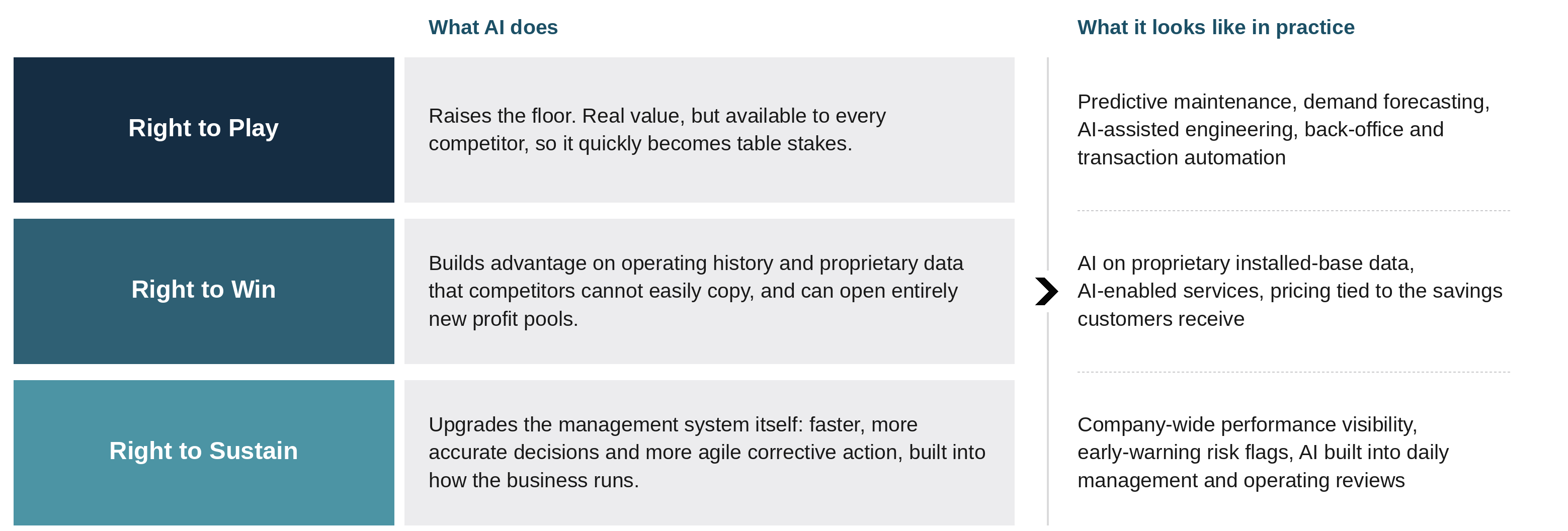
AI does not replace a company’s management system. It can accelerate parts of it, from capital allocation to performance visibility, but it cannot supply the definition of winning or design the system behind that definition by itself. The companies accumulating real AI value run one definition of winning and ask where AI can have the most meaningful impact on it.
AI will not close the distance between laggards and top performers. If anything, the gap will widen because the companies that already run their system well will extend their advantage faster. Companies chasing value from AI without a proper performance system will likely produce impressive pilots and disappointing economics.
Sustained outperformance is rare, but it is replicable with the right approach, methods, and discipline. We help industrial companies define what winning means, build the performance system that delivers bottom-line results at pace, and design and deploy the AI that sustains their advantage.
Notes and sources:
/Performance Frontier/AI_into_ROI_mdno6w)